Non-stabilizerness in quantum-enhanced metrological protocols

Tanausú Hernández-Yanes

Atomic Physics Seminar at JU

2025-10-27

The team

T. Hernández-Yanes

Piotr Sierant

Jakub Zakrzewski

Marcin Płodzień

Motivation

  • Non-stabilizerness is an interesting new quantum resource that is receiving a lot of attention
  • Implications on many-body systems relevant for quantum sensing
  • One-axis twisting is a clean metrological protocol available in many different platforms

Non-stabilizerness and Quantum Advantage
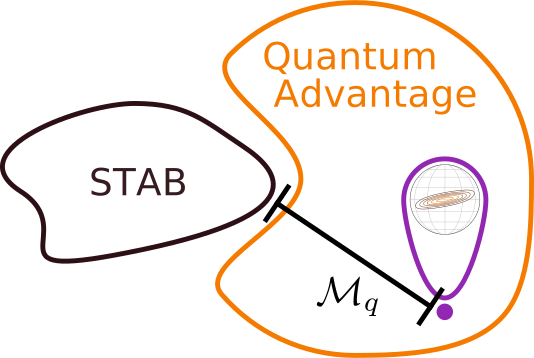
A state can achieve quantum advantage only if it contains a sufficient amount of non-stabilizerness, measured by, for instance, the stabilizer Rényi entropy \(\mathcal{M}_q\).

Stabilizer Rényi Entropy (SRE)

\[\begin{equation} \mathcal{M}_q(|\psi\rangle)=\frac{1}{1-q}\log_2\!\left(\frac{1}{2^N}\sum_{\hat{P}\in\mathcal{P}_N}\!\!\langle \psi|\hat{P}| \psi \rangle^{2q}\right) \end{equation}\]

where \(\hat{P}\) is a Pauli string, a tensor product of local Pauli operators and the identity.

  • Monotone
  • Non-negative
  • Clifford invariant
  • Additive on product states

The computational complexity of the SRE is exponential, as we need to obtain \(4^N\) expectation values.

Said complexity is reduced in the permutation invariant sector to polynomial1, \(\mathcal{O}(N^3)\).

Can we do better?

Approximated SRE for permutation invariant sector and \(N\to\infty\)

Approximated SRE

\[\begin{equation} \lim_{N \to \infty} \mathcal{M}_q \simeq \frac{1}{1-q}\log_2\left( \frac{1}{2} \sum_{\sigma\in \{X,Y,Z\}} \sum_{n=1}^2 \sum_{m=1}^2 \left(c_{n, m}^{(\sigma)}\right)^{2q} \right) ,\end{equation}\]

with coefficients

\(c^{(\sigma)}_{1,m} = |\bra{\sigma}\ket{\psi}|^2 + (-1)^m |\bra{-\sigma}\ket{\psi}|^2\), \(c^{(\sigma)}_{2,m} = \sqrt{(-1)^m}(\bra{\psi}\ket{-\sigma}\bra{\sigma}\ket{\psi} +(-1)^m \bra{\psi}\ket{\sigma}\bra{-\sigma}\ket{\psi})\).

Representation of \(\hat{P}\) in SU(2)

A natural choice is to use the angular momentum eigenstates \(\ket{J = N/2, m}\).

We choose instead the overcomplete basis of spin coherent states

\[\begin{align} \ket{\theta, \phi} =& \bigotimes_{j=1}^{2J} \left( \cos({\theta}/{2})\ket{0} + e^{-i\phi}\sin({\theta}/{2})\ket{1} \right) \\ =& \sum_{m=-J}^{J} \sqrt{2J \choose J+m} \cos^{J-m} \frac{\theta}{2} \left(\sin\frac{\theta}{2} e^{-i\phi}\right)^{J+m}\ket{J, m} \end{align}\]

Representation of \(\hat{P}\) in SU(2)

\[\begin{multline} \hat{\mathbb{I}}_{J}\hat{P}\hat{\mathbb{I}}_{J} = \left( \frac{2J+1}{4\pi} \right)^2 \int \int d\vb*{\Omega} d\vb*{\Omega'} \ket{\theta, \phi} \bra{\theta', \phi'} \\ \class{fragment grow highlight-blue}{{} \cdot \bra{\theta, \phi} \hat{P} \ket{\theta', \phi'}} \end{multline}\]

Matrix elements of \(\hat{P}\)

\[\begin{equation} \bra{\theta_i, \phi_i}\hat{P}\ket{\theta_j, \phi_j} = (\alpha_{i,j})^{N_X} (\beta_{i,j})^{N_Y} (\gamma_{i,j})^{N_Z} (\kappa_{i,j})^{N_I} ,\end{equation}\] where \(N_\sigma\) denotes the number of distinct Pauli operators \(\hat{\sigma}\) composing the Pauli string.

Implicit constraints:

\(0 \le x \le 1,\quad \forall x \in \{|\alpha_{i,j}|^2, |\beta_{i,j}|^2, |\gamma_{i,j}|^2, |\kappa_{i,j}|^2\}\),

\(|\alpha_{i,j}|^2 + |\beta_{i,j}|^2 + |\gamma_{i,j}|^2 + |\kappa_{i,j}|^2 = 2\).

Feasible constraints on \(\hat{P}\)

\(x_1, x_2, x_3, x_4 \in \mathcal{P}\{|\alpha_{i,j}|^2, |\beta_{i,j}|^2, |\gamma_{i,j}|^2, |\kappa_{i,j}|^2\}\)

  • No constraints: complicated integral with no advantage over literature results.
  • \(x_1 = x_2 = 1\): we only consider matrix elements independent of the system size \(N\).
  • \(x_1 = 1\): solvable through beta and gamma functions that yield expression (preliminary, unchecked) which only depends on \(\ket{-Z} = \otimes_{j=1}^N \ket{0}\).

Approximated \(\ev*{\hat{P}}\)

\[\begin{equation} \ev*{\hat{P}} \simeq \sum_{\sigma \in \{X,Y,Z\}} \Bigg( c_{1,N_\sigma}^{(\sigma)} \bra{\sigma}\hat{P}\ket{\sigma} + \frac{c_{2,N_{\overline{ \sigma}}}^{(\sigma)}}{\sqrt{(-1)^{N_{\overline{ \sigma}}}}} \bra{\sigma}\hat{P}\ket{-\sigma} \Bigg) \end{equation}\]

Approximated SRE

After some combinatorial calculations, we obtain

\[\begin{equation} \lim_{N \to \infty} \mathcal{M}_q \simeq \frac{1}{1-q}\log_2\left( \frac{1}{2} \sum_{\sigma\in \{X,Y,Z\}} \sum_{n=1}^2 \sum_{m=1}^2 \left(c_{n, m}^{(\sigma)}\right)^{2q} \right) \end{equation}\]

Non-stabilizerness generated by one-axis twisting

One-Axis Twisting (OAT)

\[\begin{equation} \ket{\psi(t)} = \exp\left\{-i \frac{\chi t}{4 \hbar}\hat{Z}^2 \right\} \ket{X},\quad \hat{Z} \equiv \sum_j \hat{Z}_j \end{equation}\]
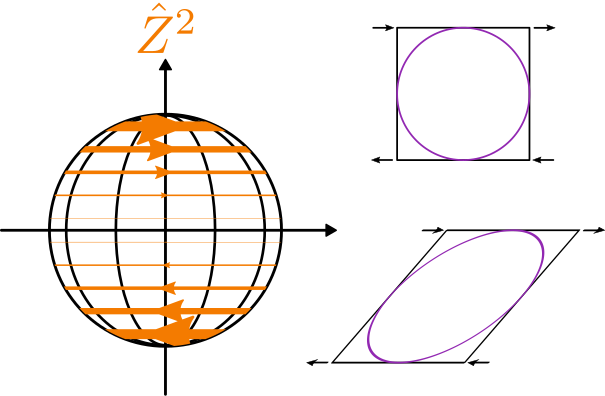
\[ \xi^2 = N \frac{\min_{\vb*{n}} (\Delta \hat{\sigma}_{\perp, \vb*{n}}^2 )}{\ev*{\hat{X}}^2} \gtrsim N^{-2/3} \]

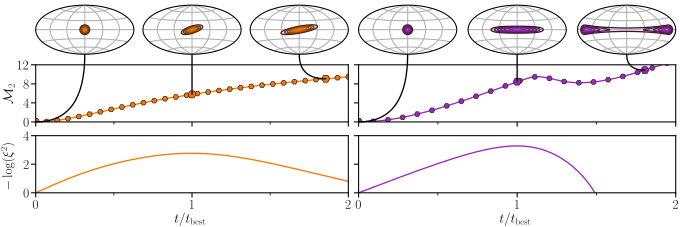
SRE during squeezing time scale

\(t \lesssim t_\mathrm{best}\)
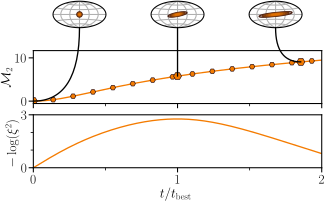
\(N=100\)

SRE scaling for squeezed states
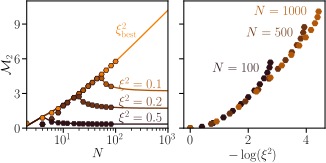
SRE and many-body Bell correlations

\[\begin{equation} Q = \log_2(2^N {\mathcal E})<0,\quad {\mathcal E}= \left|\frac{1}{N!}\ev{\left(\frac{\hat Y +i\hat Z}{2}\right)^N}\right|^2 \end{equation}\]

  • \(Q \leq 0\) for separable states
  • \(Q \geq N - k\) detects non-\(k\)-separability
  • \(Q = N - 2\) for the GHZ state along x-axis

\(Q\) scaling for squeezed states

\[ Q(t = t_\mathrm{best}) \approx N - aN^{1/3} \]

At \(t_\mathrm{best}\), SRE scales with \(\log_2(N)\) while \(Q\) scales sub-linearly with \(N\).

What about other metrologically useful states?

SRE for kitten states

\(\chi t \leq \frac{\pi}{2}\)
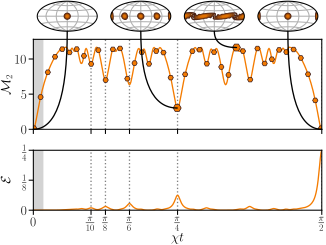
\(N=100\)

\(Q\) and SRE scaling for kitten states
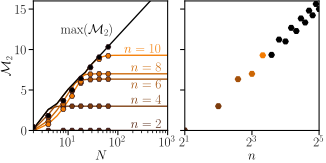
SRE is fixed, but grows with \(n\), while \(Q \simeq N-2\log_2(n)\). Anti-correlation of SRE and \(Q\) for kitten states.

Complementary results

Two-axis counter-twisting (TACT)

\[\begin{equation} \ket{\psi(t)} = \exp\left\{-i \frac{\chi t}{4 \hbar}(\hat{Z}\hat{Y} + \hat{Y}\hat{Z}) \right\} \ket{X} \end{equation}\]
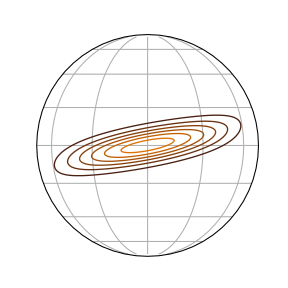
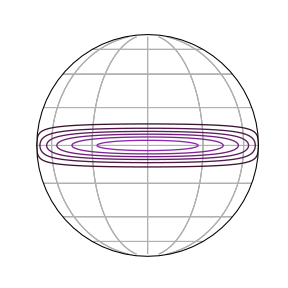
OAT, \(N=100\), \(\xi^2 \gtrsim N^{-2/3}\).

TACT, \(N=100\), \(\xi^2 \gtrsim N^{-1}\).

SRE of squeezed states under TACT

\(N=100\)

Same conclusions as OAT.

SRE scaling of squeezed states under TACT
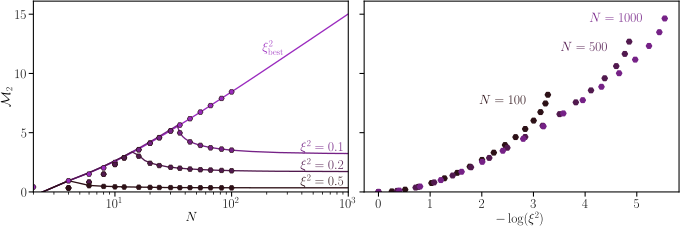
Same conclusions as OAT.

Dicke states with zero magnetization

\[\begin{equation} \lim_{N\to\infty} \mathcal{M}_q(\ket{J = N/2, 0}) \simeq \frac{q}{q-1}\log_2\left(\frac{\pi N}{8}\right) - \frac{1}{q-1} \end{equation}\]
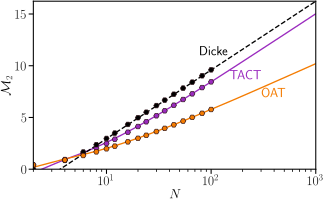
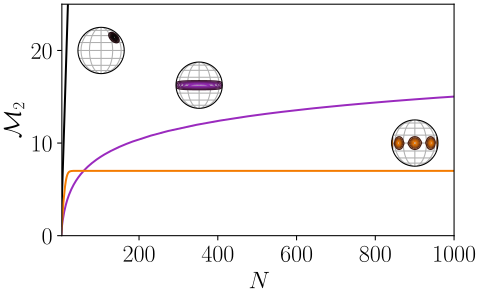
SRE scaling of best squeezed states under OAT and TACT, and \(\ket{J = N/2, 0}\).

\[ Q \approx N - \log_2 N + \log_2 \frac{2}{\pi} \]

Generalized GHZ states

\[\begin{equation} \frac{1}{\sqrt{K}}\left( \ket{\theta=0, \phi=0} + \ket{\theta = 2\epsilon, \phi=0} \right) \end{equation}\]
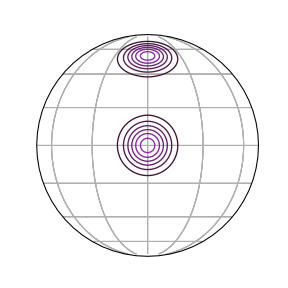
Conclusions

  • Approximated SRE for permutation symmetric sector at large \(N\) only requires six state projections
  • Spin squeezing generation implies an SRE increase
  • Fixing the squeezing level also fixes the SRE
  • The SRE of kitten states is fixed for large \(N\) but grows with the kitten size \(n\), while larger kittens imply smaller Bell correlations \(Q\)

Thank you

Extra slides

Comparing SRE scalings

\(\ket{\theta = \acos(3^{-1/2}), \phi = \pi / 4 }\) (black), best squeezed state for TACT (purple), and kitten state with \(n=8\) (orange).

Husimi functions for OAT and \(t < \pi / 2\)

\(Q\) scaling for fixed squeezing level
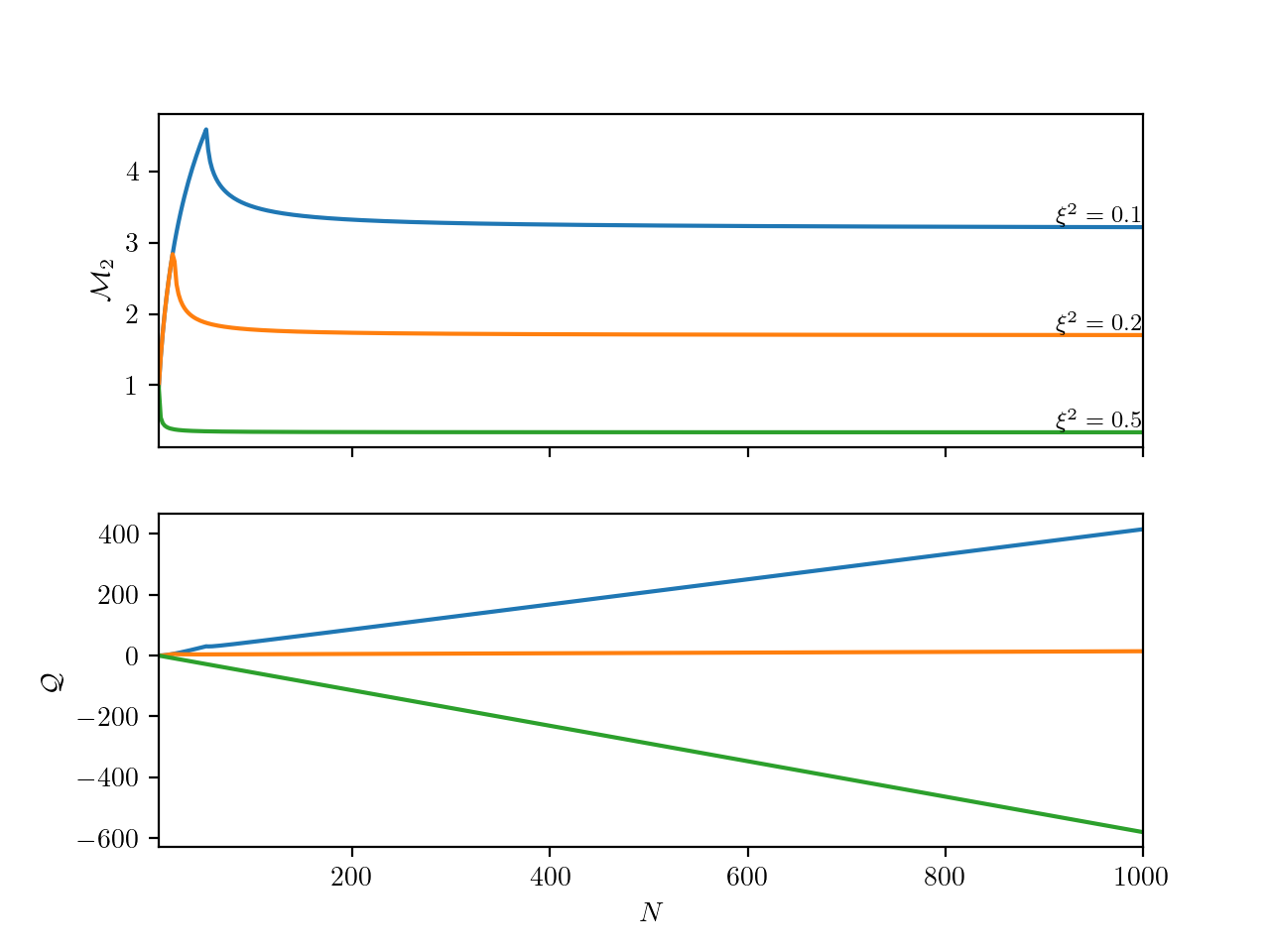
Coherence and SRE under OAT
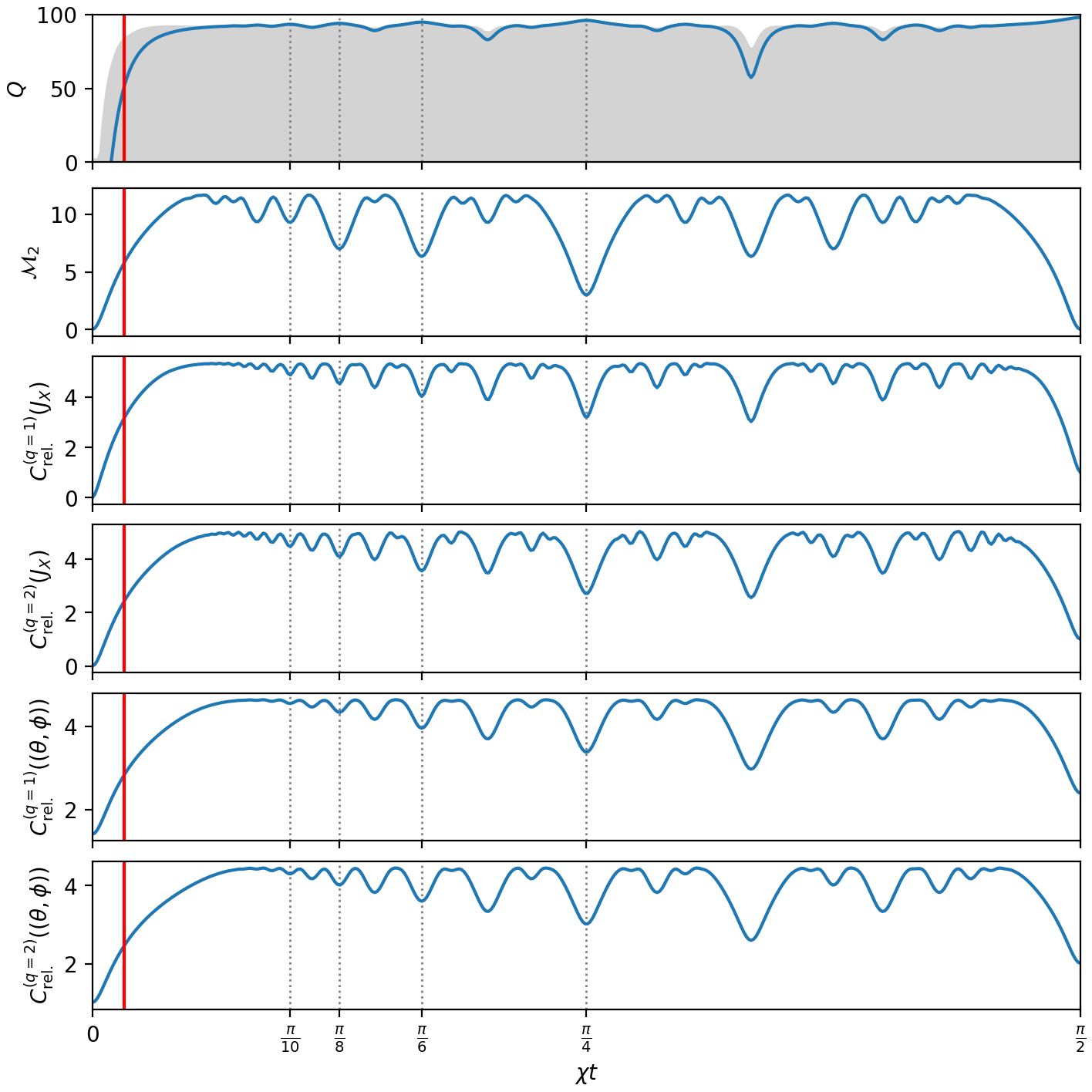
\(N=100\)

Dicke states scaling
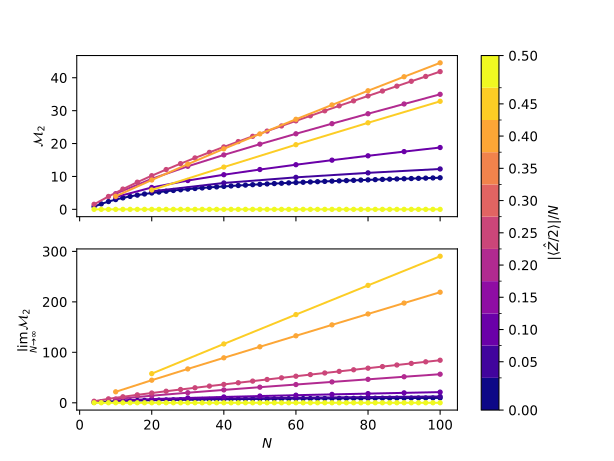
Corrections to the Approximated SRE
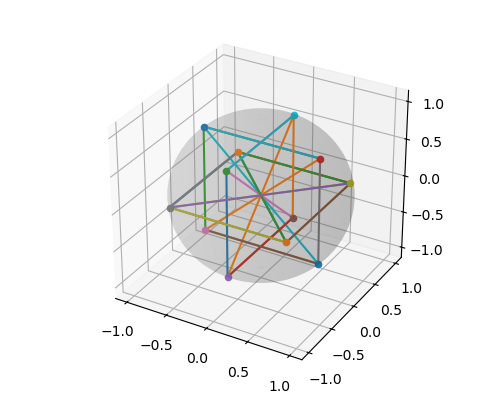
First order corrections.

Second order corrections.

Example state: Generalized GHZ state

\[ \ket{\theta = 0, \phi = 0} + \ket{\theta = \pi/3, \phi = 0} \]
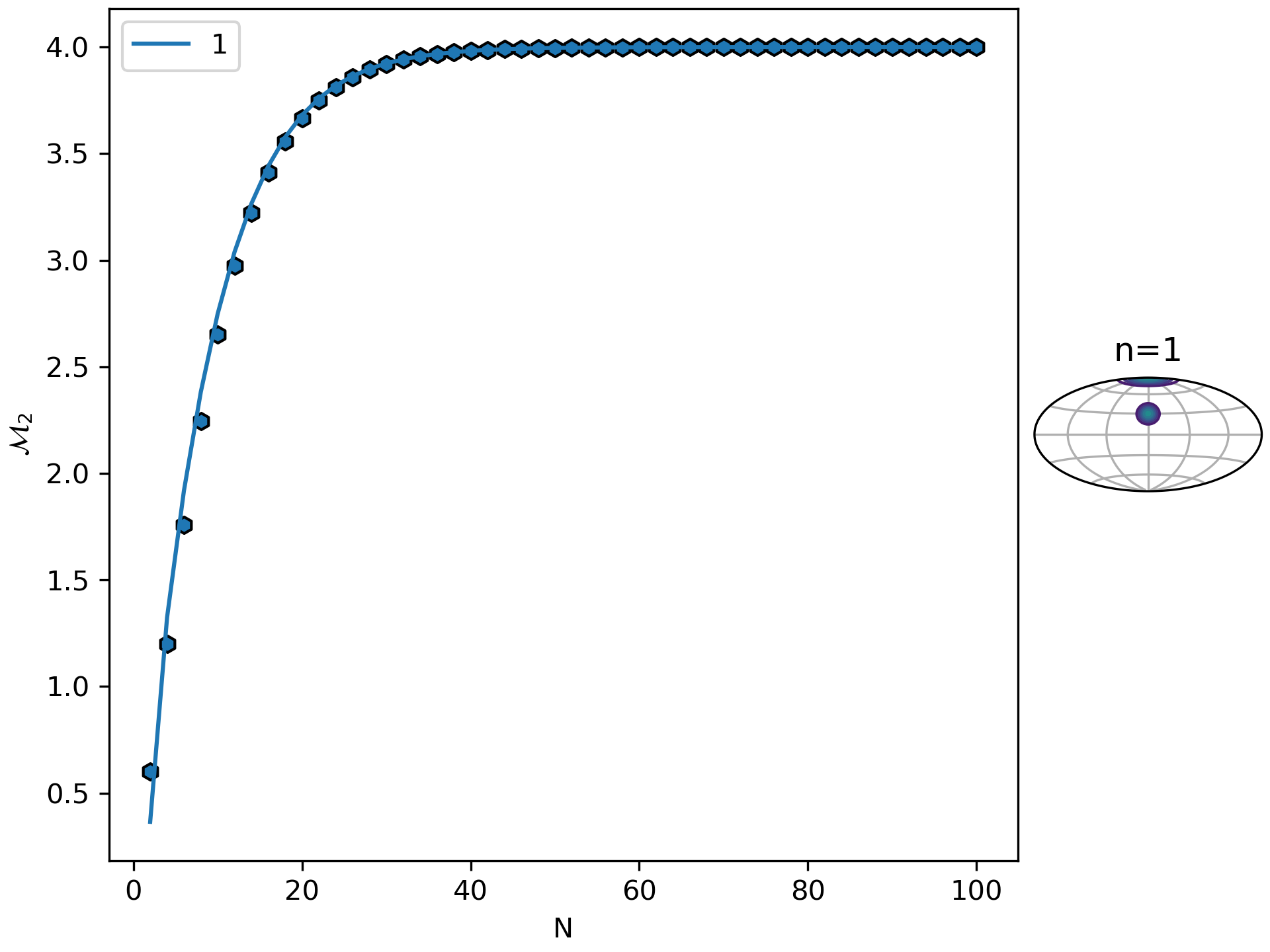
Pauli spectra of generalized GHZ state
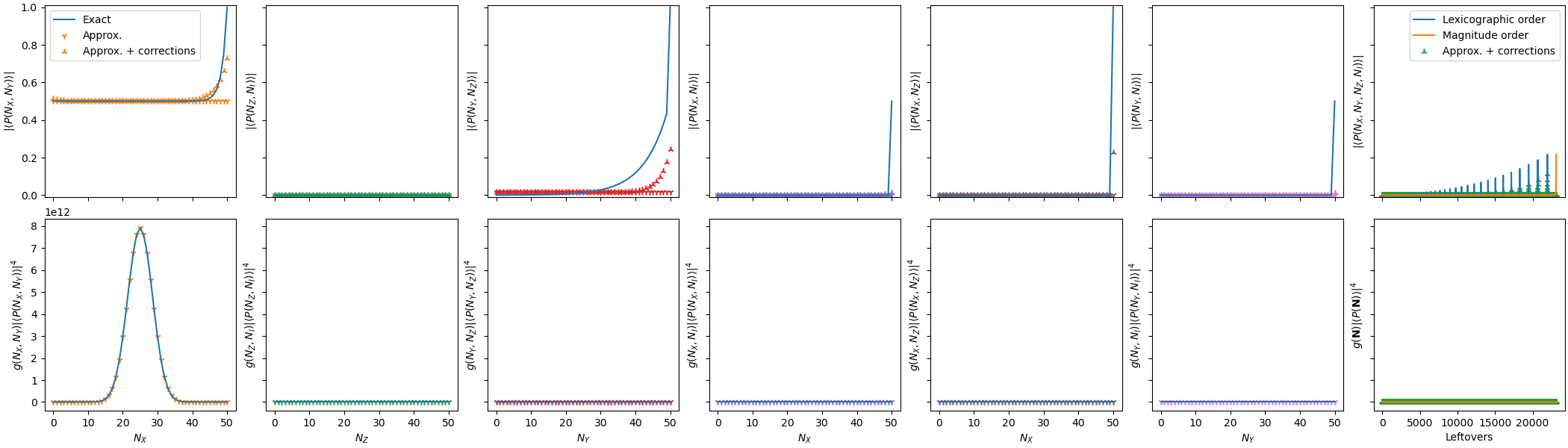
\(N=50\)

Example state: Rotated coherent state

\[ \ket{\theta = \acos(3^{-1/2}), \phi = \pi/4} \]
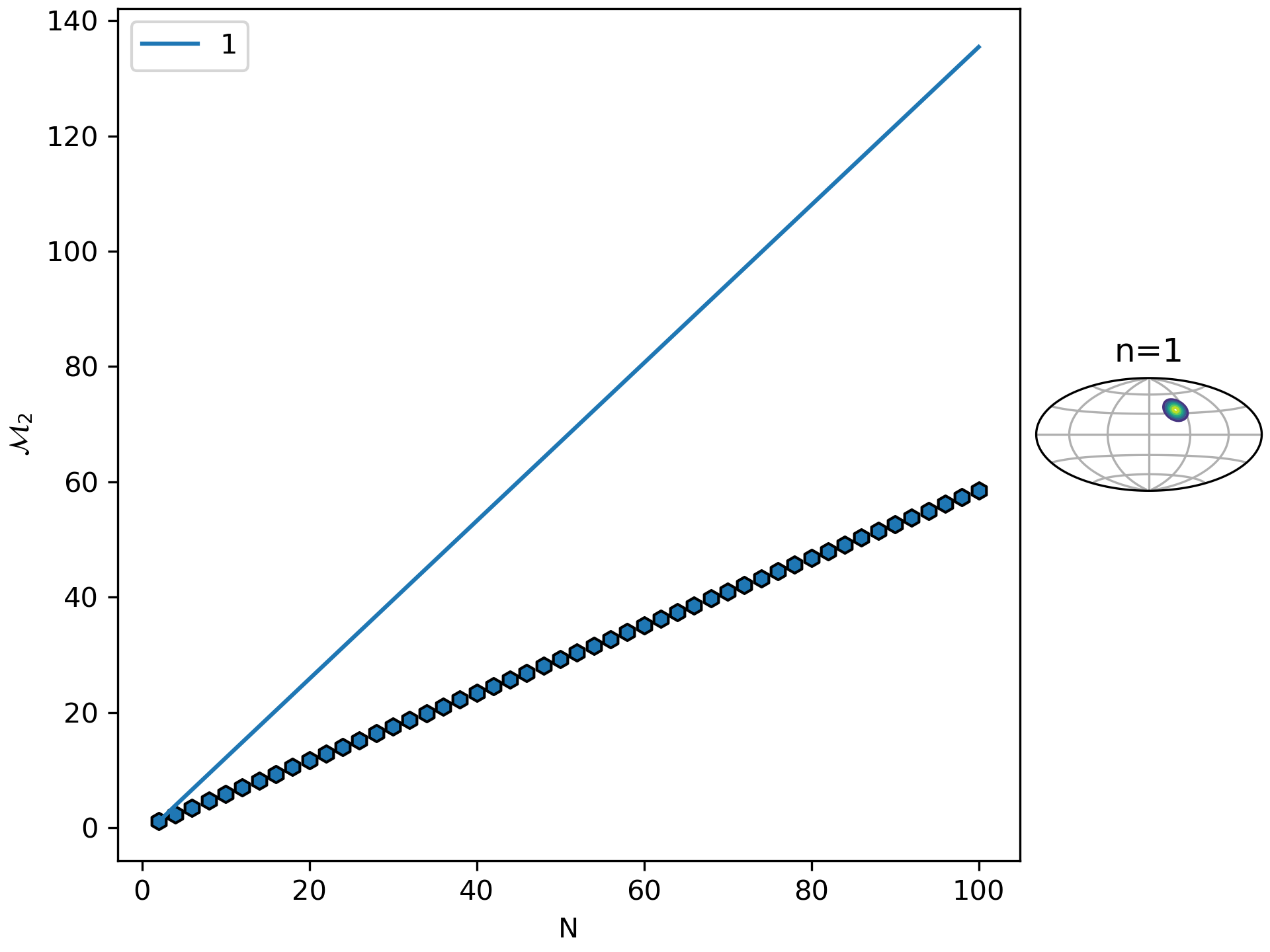
Pauli Spectra of rotated coherent state
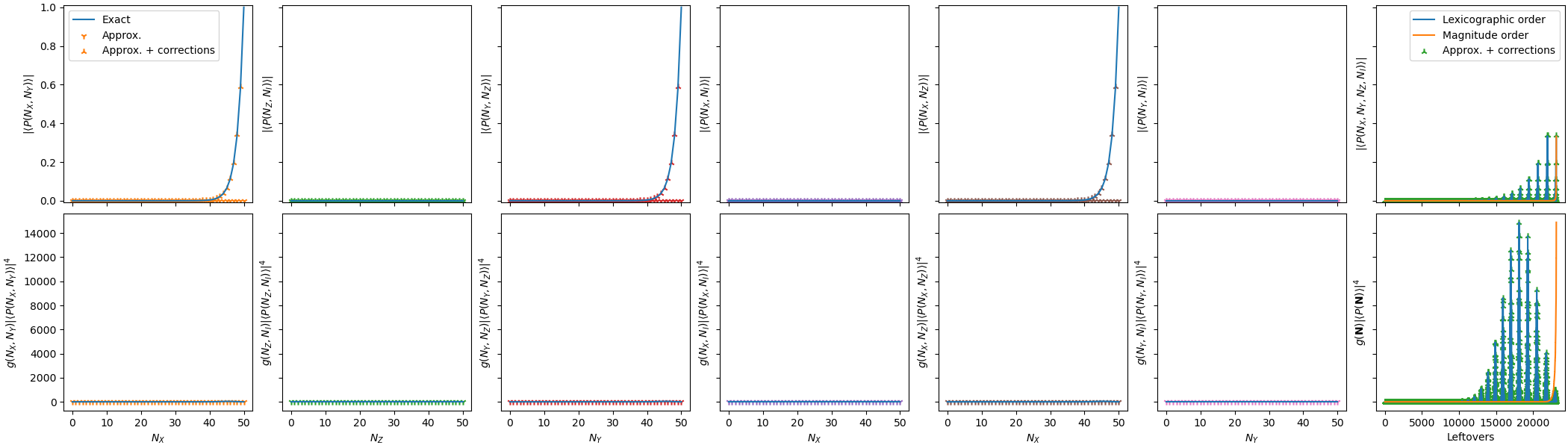
\(N=50\)

Example state: Dicke state with magnetization \(N/4\)

\[\ket{J=N/2, m = N/4}\]
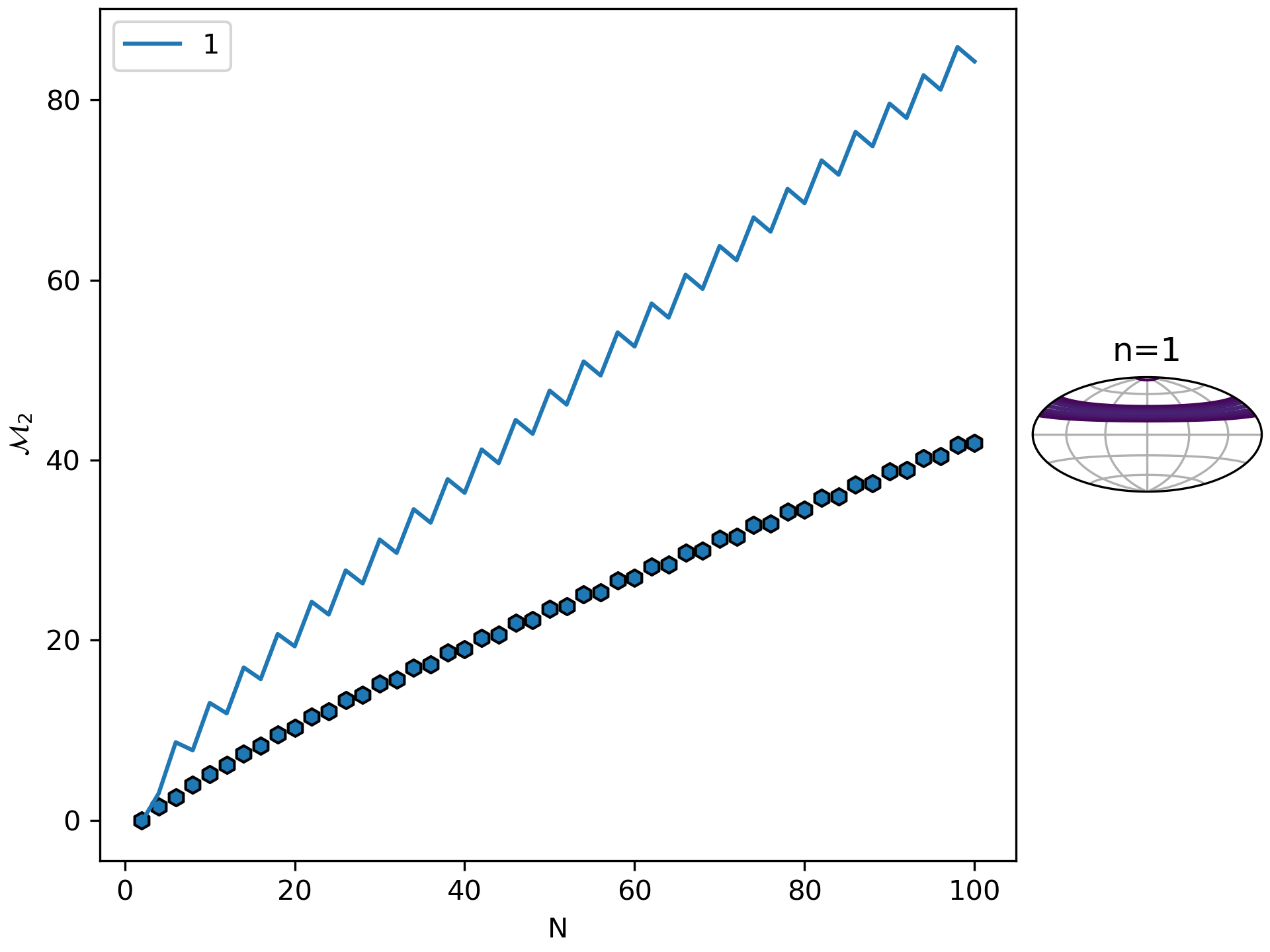
Pauli spectra of Dicke state with magnetization \(N/4\)
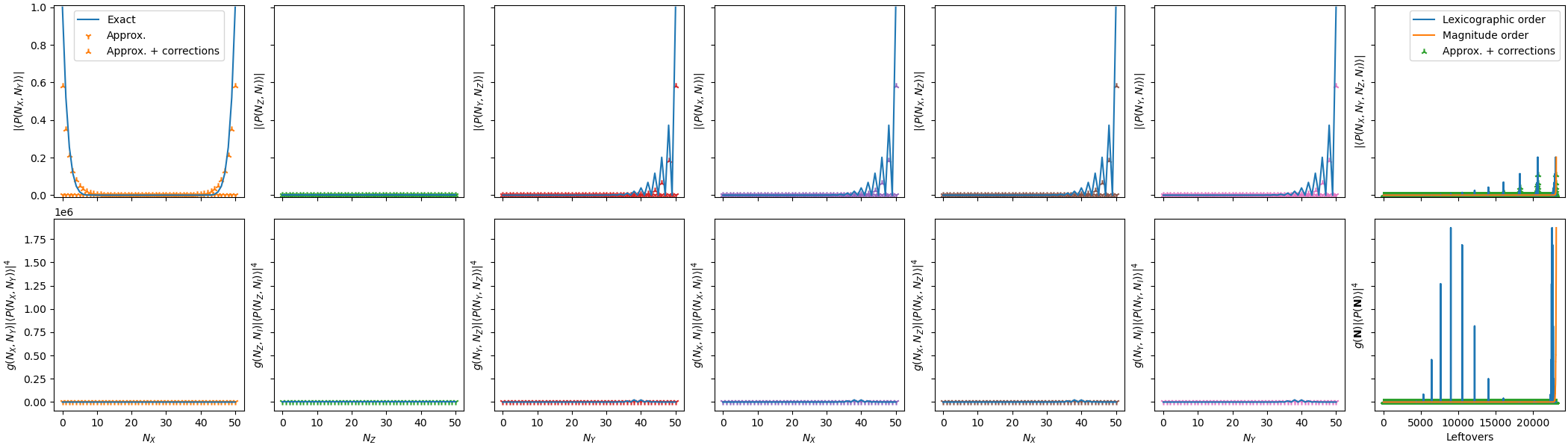
\(N=50\)