Relating Non-stabilizerness to Other Quantum Resources
2025-10-27
Non-stabilizerness and Quantum Computing
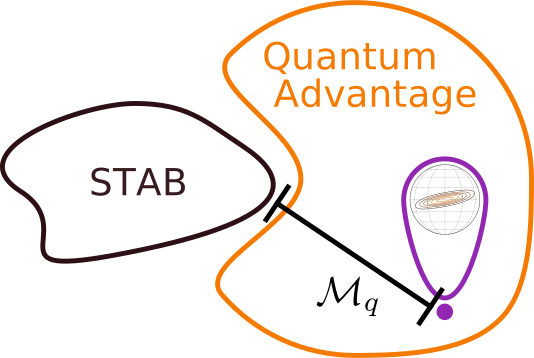
A state can achieve quantum advantage only if it contains a sufficient amount of non-stabilizerness, measured by, for instance, the stabilizer Rényi entropy \(\mathcal{M}_q\).
- Quantum error correction
- Fault-tolerant quantum computing
Non-stabilizerness in Particle Physics

Shalma Wegsman, Particle Physicists Detect ‘Magic’ at the Large Hadron Collider, Quanta Magazine (2025)
The Stabilizer Polytope
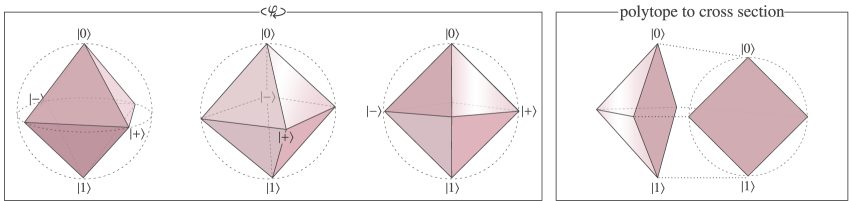
\[ \rho = \frac{1}{2}(1 + \vec{r}\cdot\vec{\sigma}) \rightarrow |r_x| + |r_y| + |r_z| \le 1 \]
\[ \mathcal{NS}(\rho) = \min_{\sigma\in\text{STAB}} \frac{1}{2}|| \rho - \sigma||_1 \]
Non-stabilizerness and Entanglement
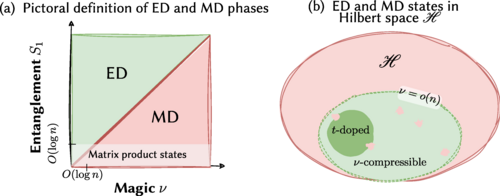
- Study of divide from a computation perspective
- Separation based on stabilizer nullity \(\nu\) and entanglement entropy \(S_1\)
Non-stabilizerness and Fermionic Non-Gaussianity
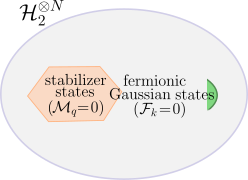
- Fermionic Gaussian states and unitaries constructed from Majorana fermion operators
- Analogous construction to stabilizer states
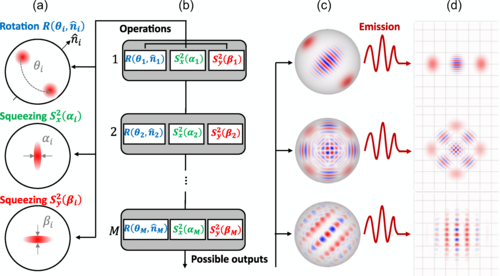
Universal Operation Set for Permutationally Symmetric States
- Bosonic states can be universally manipulated with operations that mix Clifford and non-Clifford operations
- For permutationally symmetric states, this universal set can be described with rotations and one-axis twisting only1
The Team








Comparing Stabilizer Rényi Entropy Scalings
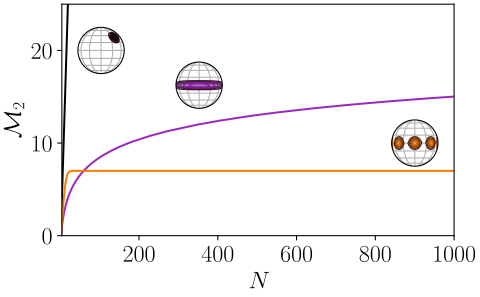
\(\ket{\theta = \acos(3^{-1/2}), \phi = \pi / 4 }\) (black), best squeezed state for TACT (purple), and kitten state with \(n=8\) (orange).
One-Axis Twisting (OAT)
\[\begin{equation} \ket{\psi(t)} = \exp\left\{-i \frac{\chi t}{4 \hbar}\hat{Z}^2 \right\} \ket{X},\quad \hat{Z} \equiv \sum_j \hat{Z}_j \end{equation}\]
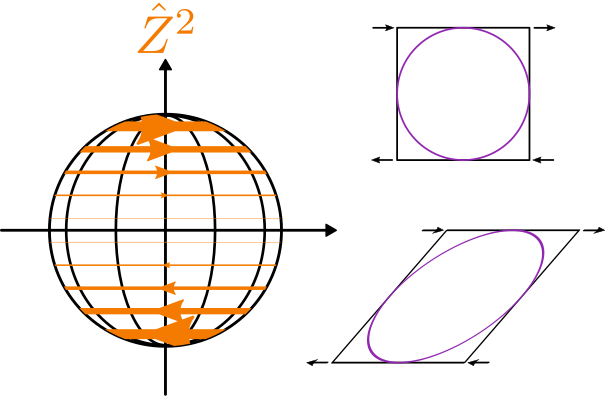
\[ \xi^2 = N \frac{\min_{\vb*{n}} (\Delta \hat{\sigma}_{\perp, \vb*{n}}^2 )}{\ev*{\hat{X}}^2} \gtrsim N^{-2/3} \]
SRE at Squeezing Time Scale
\(t \lesssim t_\mathrm{best}\)
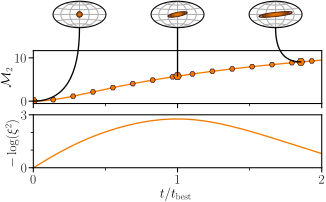
\(N=100\)
SRE Scaling of Squeezed States
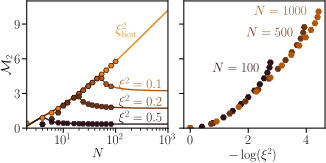
SRE of Kitten States
\(\chi t \leq \frac{\pi}{2}\)
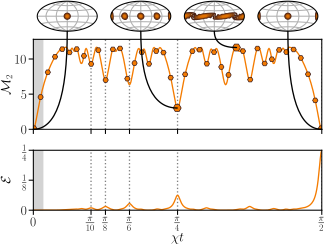
\(N=100\)
\(Q\) and SRE Scaling of Kitten States
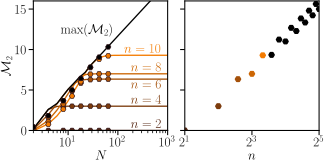
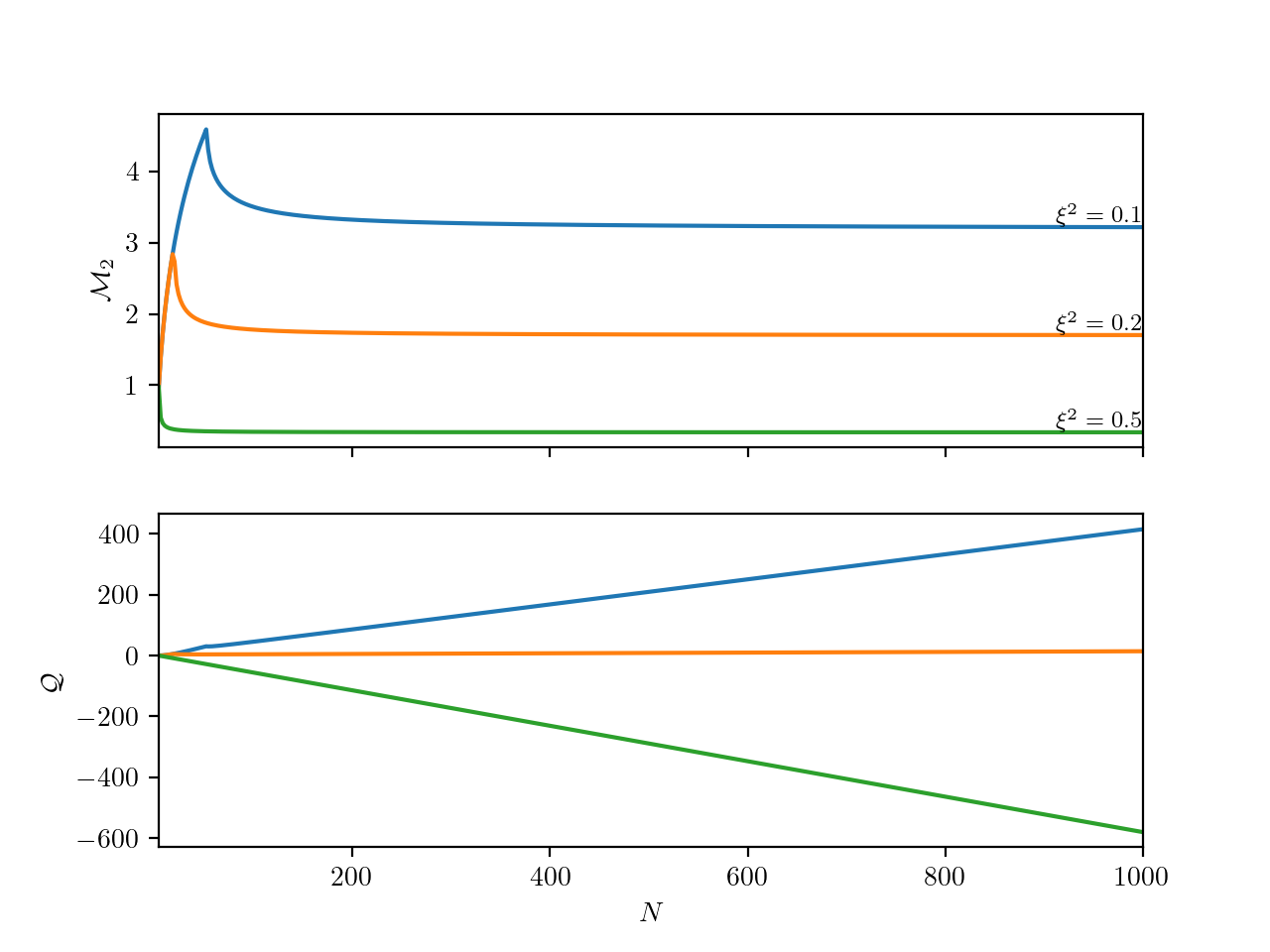
SRE is fixed, but grows with \(n\), while \(Q \simeq N-2\log_2(n)\). Anti-correlation of SRE and \(Q\) for kitten states.
Two-axis Counter-twisting (TACT)
\[\begin{equation} \ket{\psi(t)} = \exp\left\{-i \frac{\chi t}{4 \hbar}(\hat{Z}\hat{Y} + \hat{Y}\hat{Z}) \right\} \ket{X} \end{equation}\]
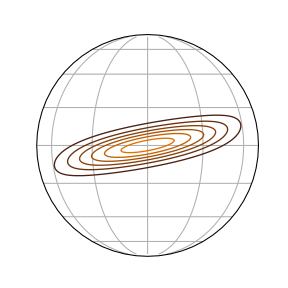
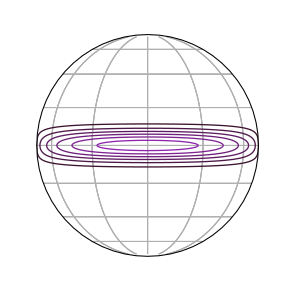
SRE of Squeezed States under TACT
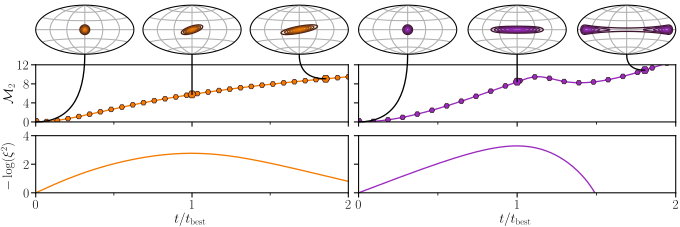
\(N=100\)
Same conclusions as OAT.
SRE Scaling of Squeezed States under TACT
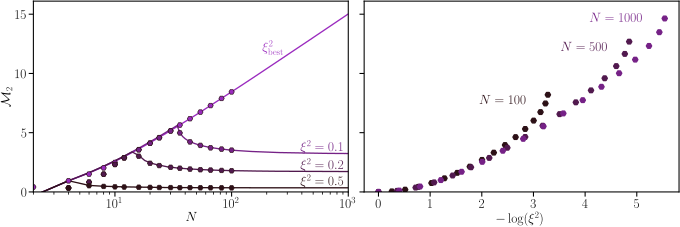
Same conclusions as OAT.
Dicke States with Zero Magnetization
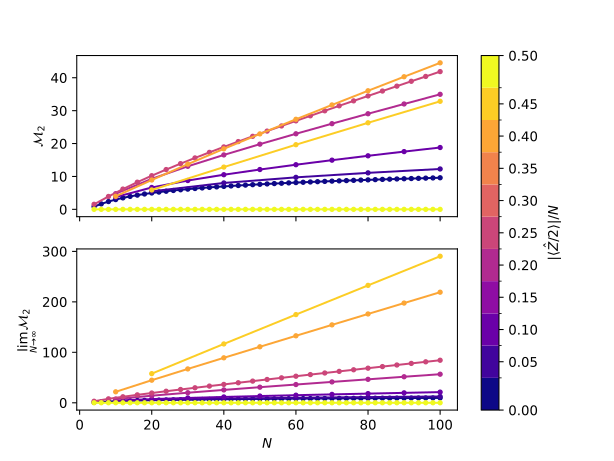
\[\begin{equation} \lim_{N\to\infty} \mathcal{M}_q(\ket{J = N/2, 0}) \simeq \frac{q}{q-1}\log_2\left(\frac{\pi N}{8}\right) - \frac{1}{q-1} \end{equation}\]
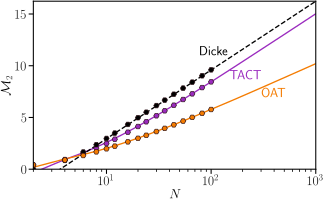
SRE scaling of best squeezed states under OAT and TACT, and \(\ket{J = N/2, 0}\).
\[ Q \approx N - \log_2 N + \log_2 \frac{2}{\pi} \]
Generalized GHZ States
\[\begin{equation} \frac{1}{\sqrt{K}}\left( \ket{\theta=0, \phi=0} + \ket{\theta = 2\epsilon, \phi=0} \right) \end{equation}\]
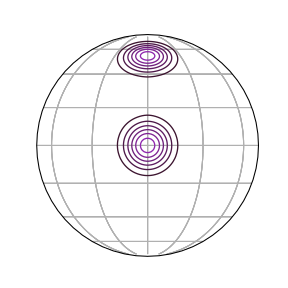
.svg)
\(Q\) scaling for fixed squeezing level
Coherence and SRE under OAT
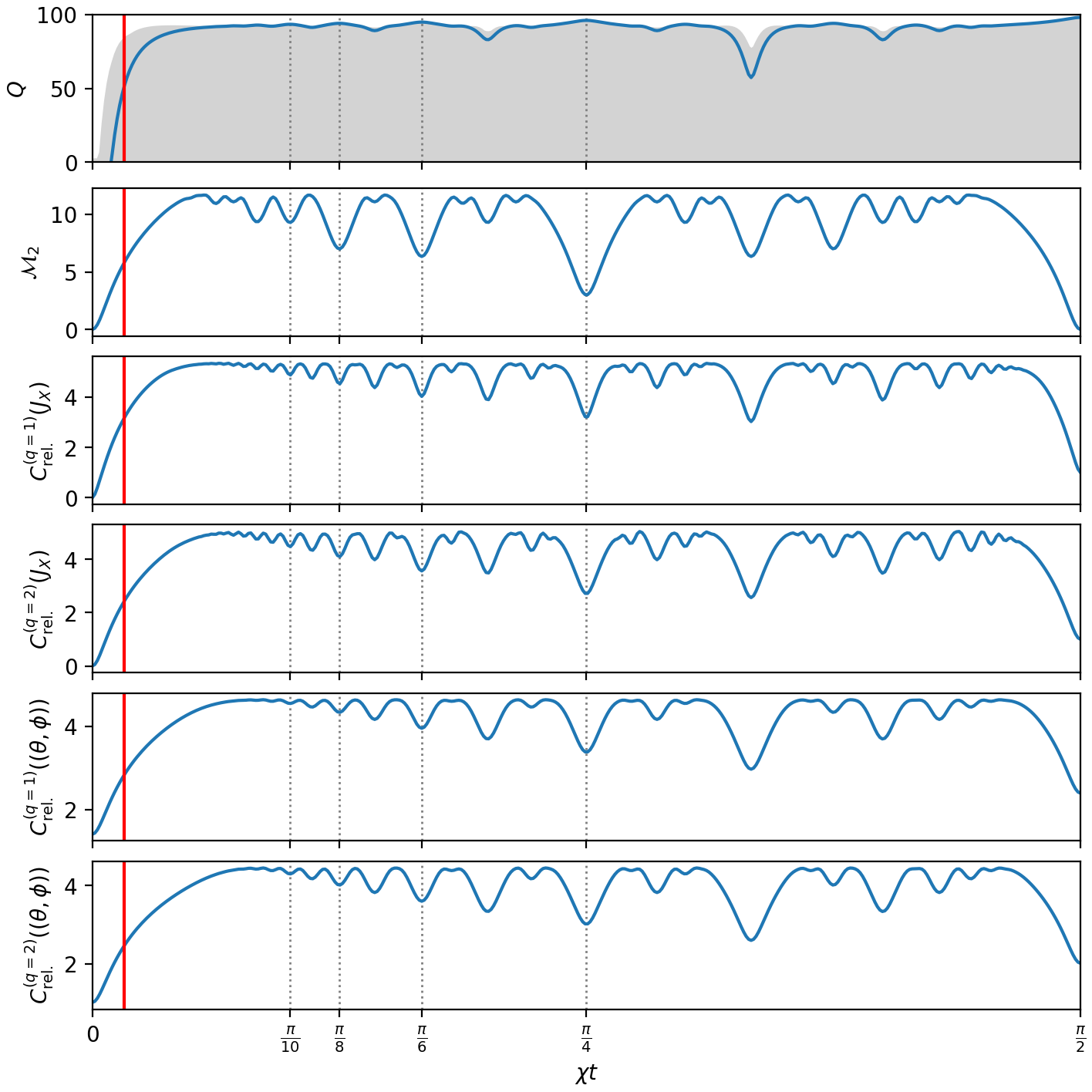
\(N=100\)
Dicke states scaling
Corrections to the Approximated SRE
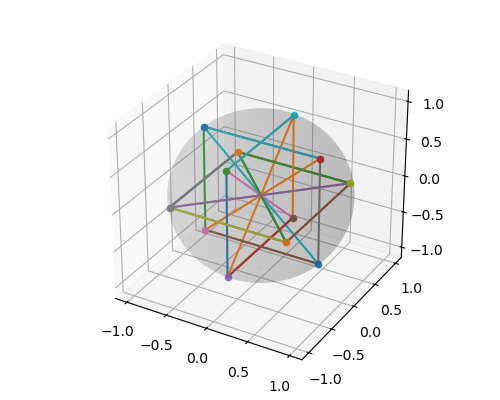
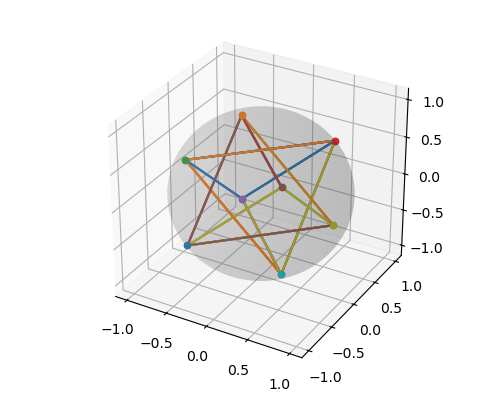
Example state: Generalized GHZ state
\[ \ket{\theta = 0, \phi = 0} + \ket{\theta = \pi/3, \phi = 0} \]
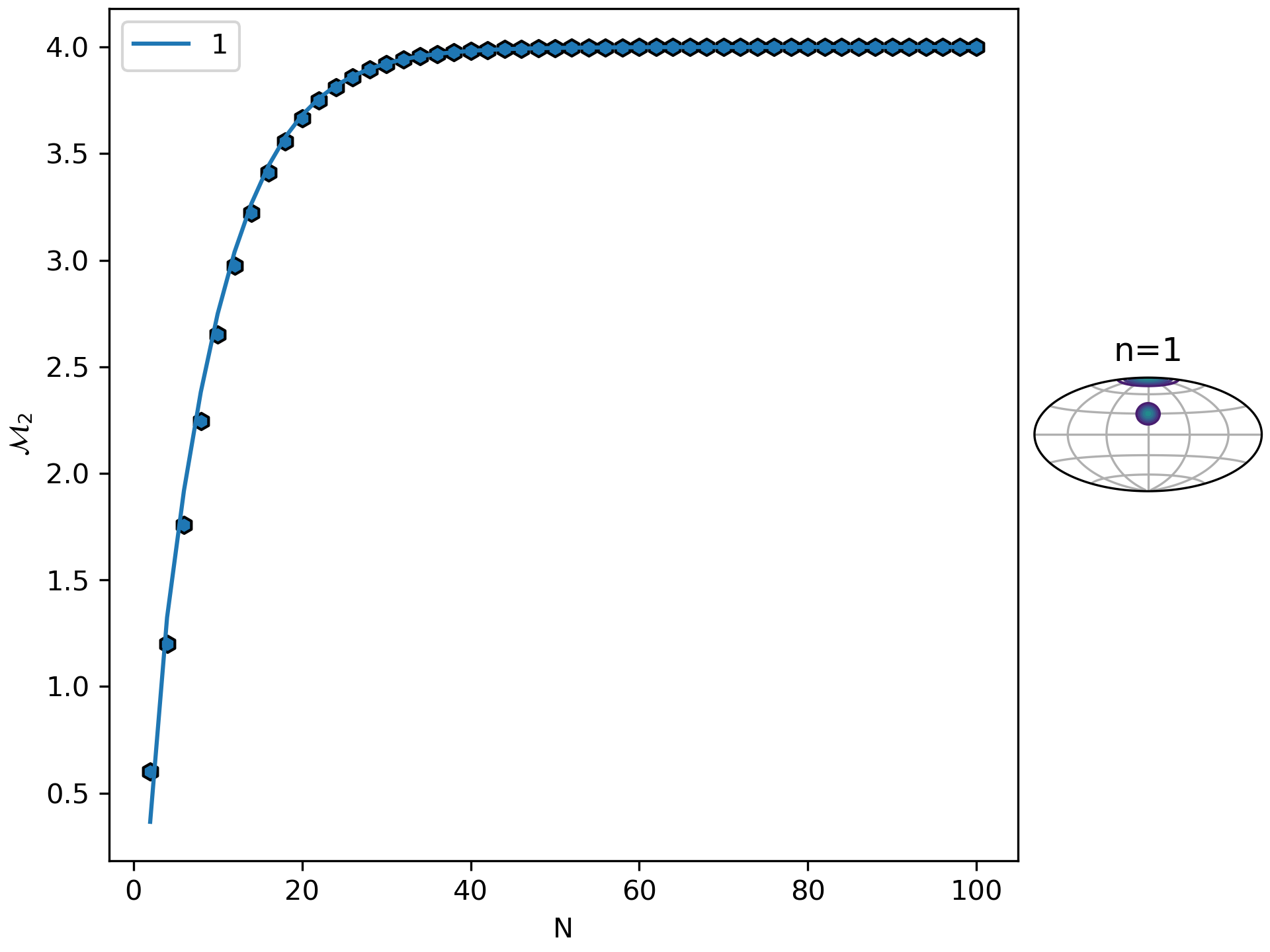
Pauli spectra of generalized GHZ state
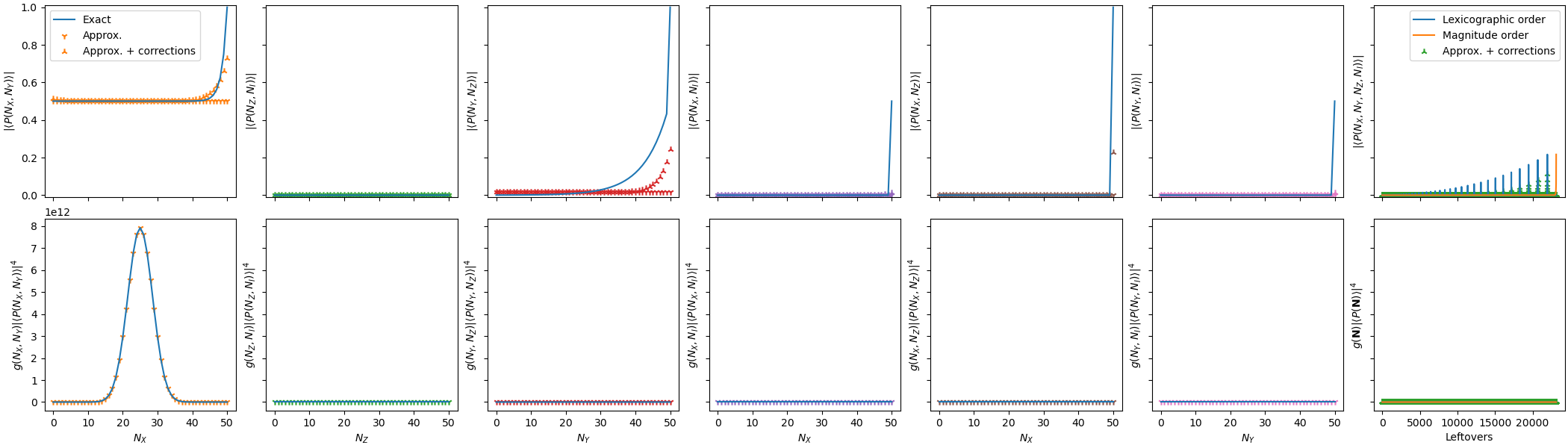
\(N=50\)
Example state: Rotated coherent state
\[ \ket{\theta = \acos(3^{-1/2}), \phi = \pi/4} \]
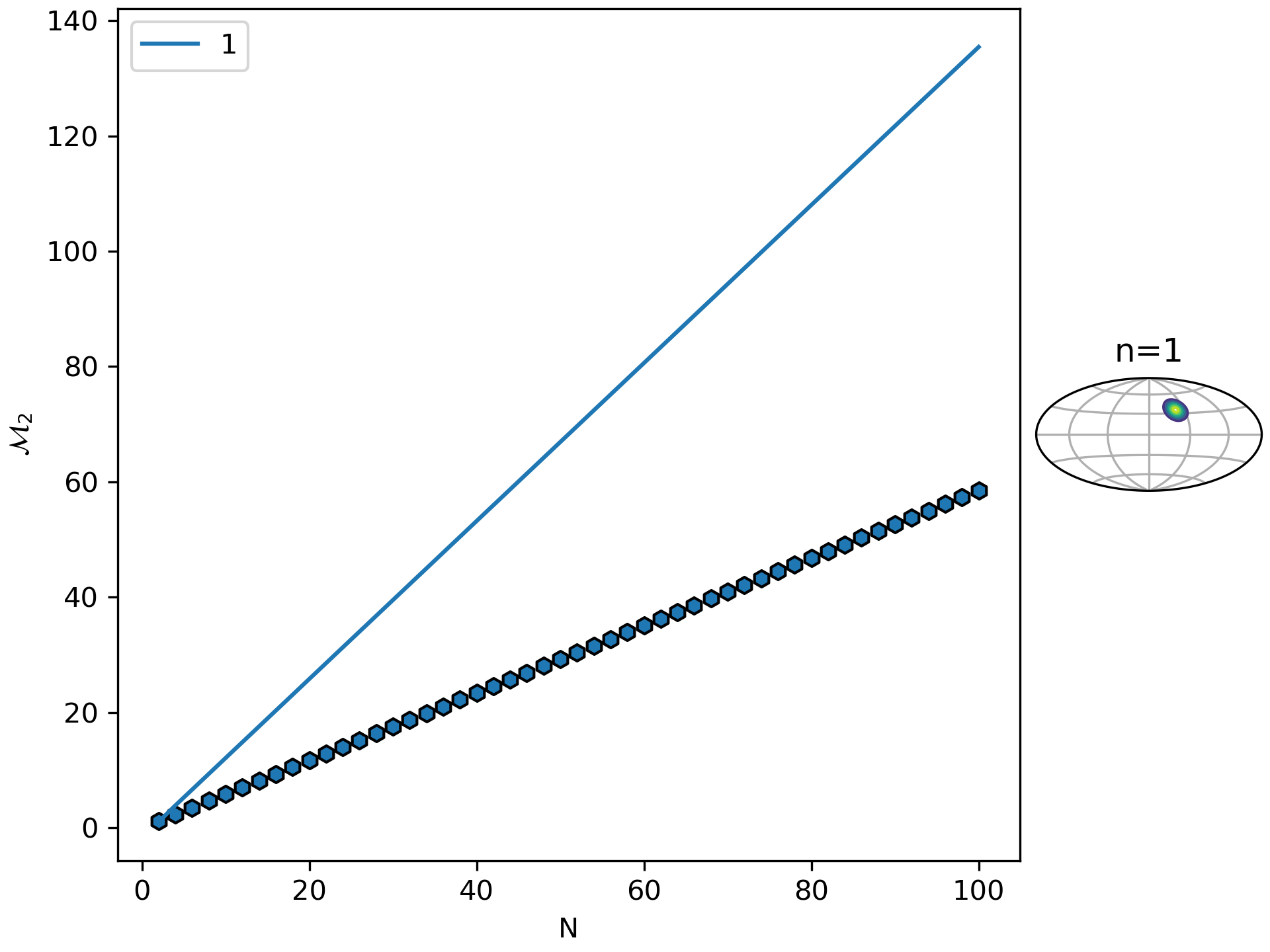
Pauli Spectra of rotated coherent state
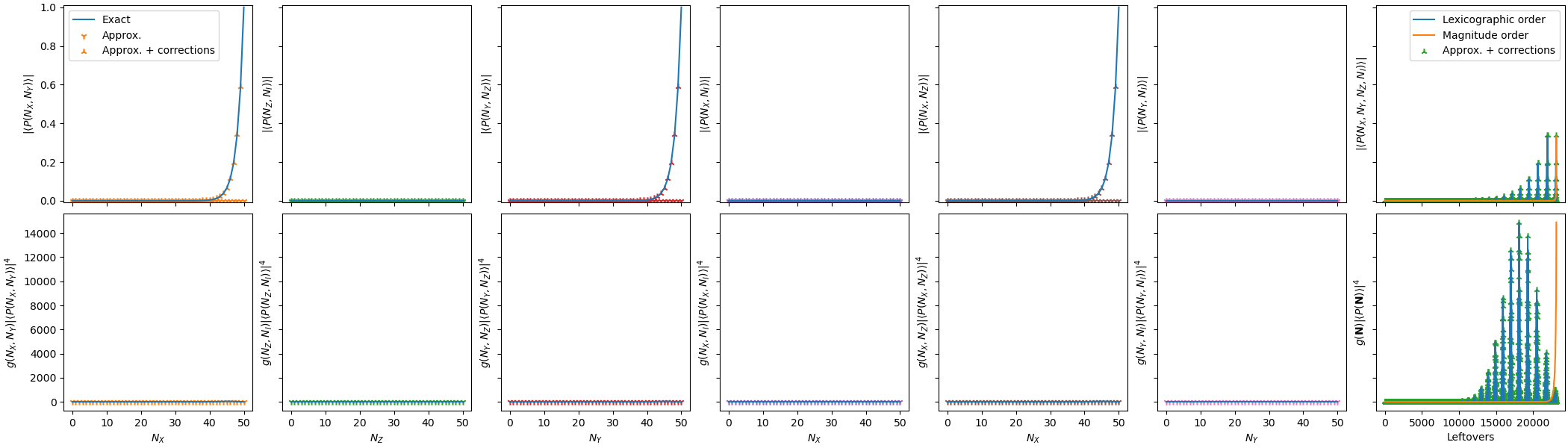
\(N=50\)
Example state: Dicke state with magnetization \(N/4\)
\[\ket{J=N/2, m = N/4}\]
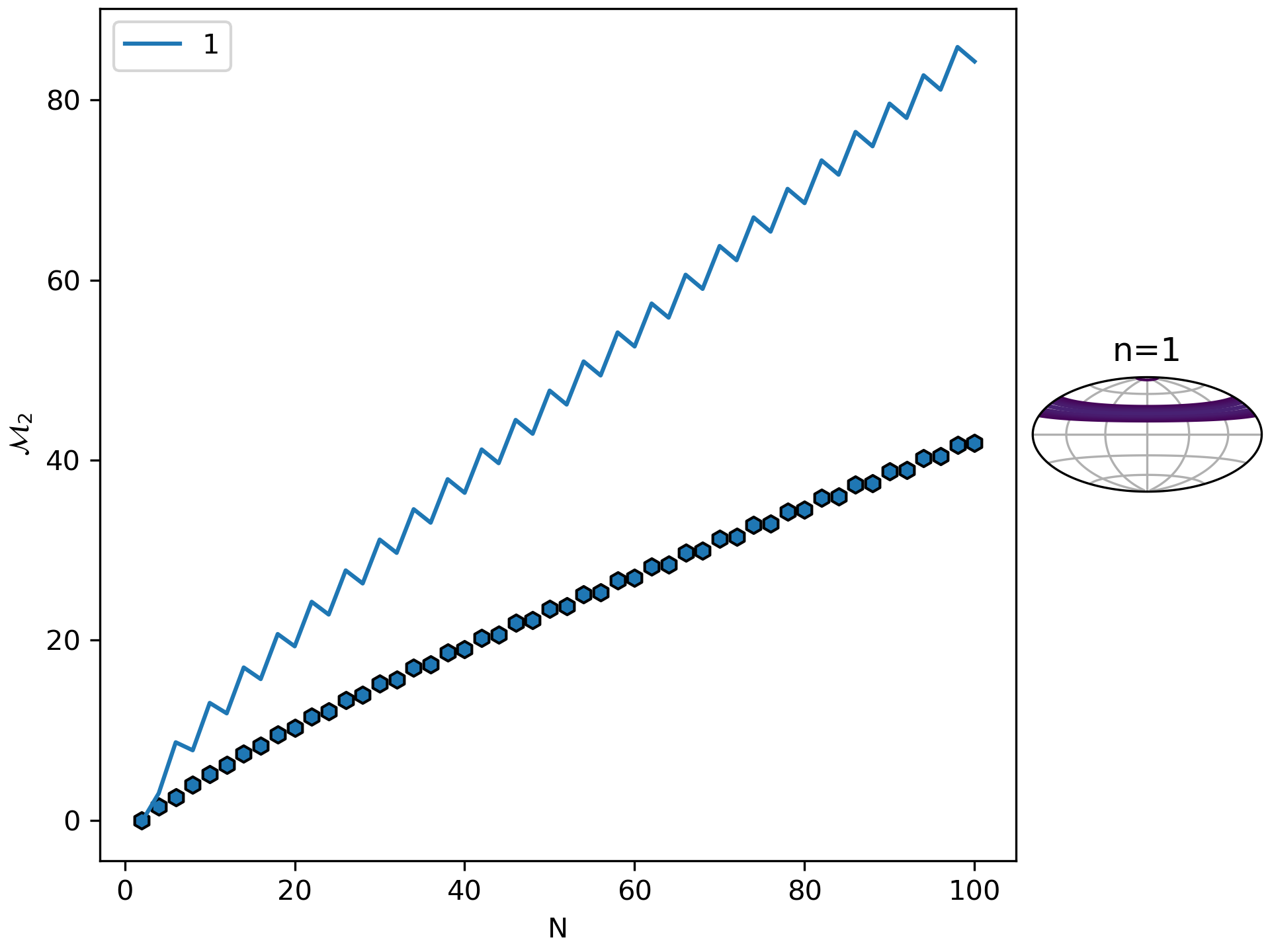
Pauli spectra of Dicke state with magnetization \(N/4\)
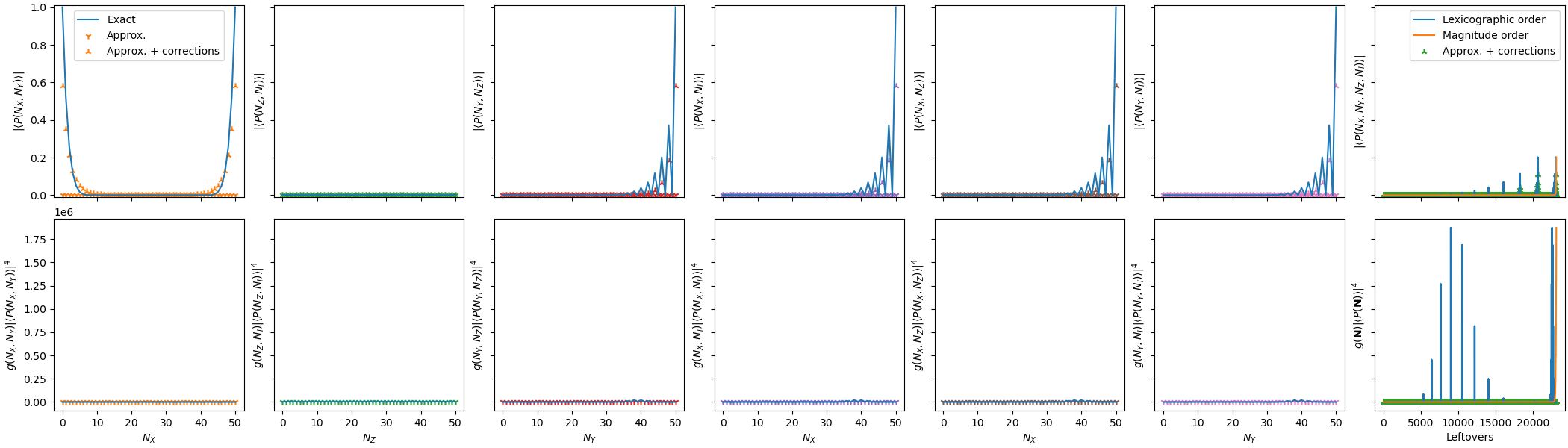
\(N=50\)