The Team
Non-stabilizerness is an interesting new quantum resource that is receiving a lot of attention
Implications on many-body systems relevant for quantum sensing
One-axis twisting is a clean metrological protocol available in different platforms
Non-stabilizerness and Computing
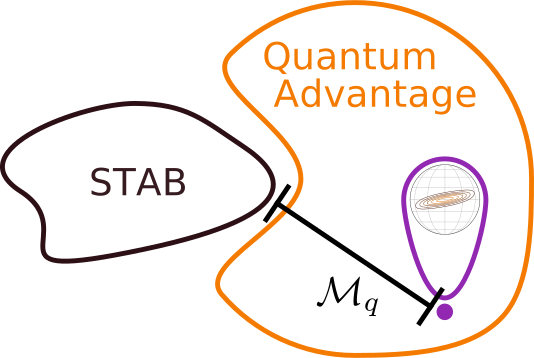
A state can achieve quantum advantage only if it contains a sufficient amount of non-stabilizerness, measured by, for instance, the stabilizer Rényi entropy \(\mathcal{M}_q\) .
Quantum error correction
Fault-tolerant quantum computing
Non-stabilizerness and Other Resources
Entanglement-dominated states are operationally easier to manipulate than magic-dominated ones1
Stabilizer states are completely non-contextual2
Quantum chaos is exponentially expensive for classical simulation based on stabilizer formalism3
Stabilizer States
Construction analogous to classical linear codes
Eigenstates of the tensor product of local Pauli operators with eigenvalue \(+1\) ( \(\hat{P} \ket{\psi} = \ket{\psi}\) , \(\hat{P}\) stabilizes \(\ket{\psi}\) )
Highly entangled states can also be stabilizer states, see \(\hat{X}_1\hat{X}_2\) and \(\hat{Z}_1\hat{Z}_2\) acting on \(\ket{\psi} = \frac{1}{\sqrt{2}}(\ket{00} + \ket{11})\)
Many states are easier to describe through the operators that stabilize them
Gottesman-Knill theorem: stabilizer states can be simulated classically in polynomial time
One extra operation needed for universal set for quantum computation
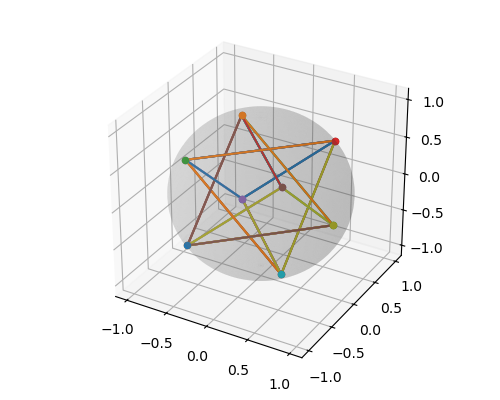
The Stabilizer Polytope
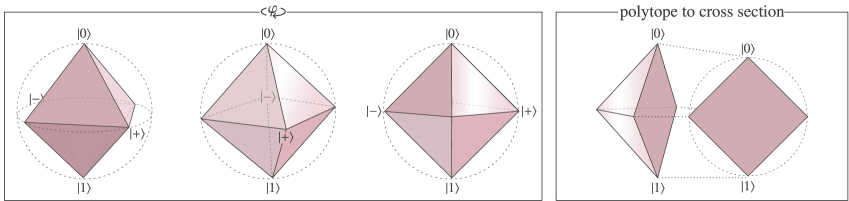
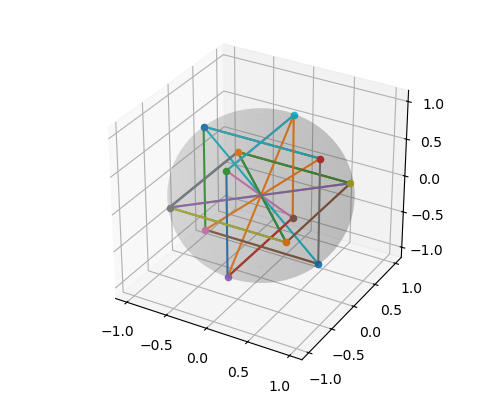
For a single qubit, the polytope is defined by the convex mixture of its six Pauli eigenstates
\[\text{conv} \left\{\frac{1+\vec{a}\cdot\vec{\sigma}}{2}\right\}_{\vec{a}\in{\pm \vec{x}, \pm \vec{y}, \pm \vec{z}}} \]
Victor Veitch et al, Negative quasi-probability as a resource for quantum computation, New J. Phys. 14 (2012)
A. Oliveira et al,
\[ \rho = \frac{1}{2}(1 + \vec{r}\cdot\vec{\sigma}) \rightarrow |r_x| + |r_y| + |r_z| \le 1 \]
\[
\mathcal{NS}(\rho) = \min_{\sigma\in\text{STAB}} \frac{1}{2}|| \rho - \sigma||_1
\]
Stabilizer measures
Relative entropy is a well defined monotone for any resource
\[ r_{\mathcal{M}} (\rho) = \min_{\sigma\in \text{STAB}} S(\rho || \sigma) \]
Stabilizer measures
Stabilizer Rényi Entropy (SRE) is faithful, and does not require minimization
\[\begin{equation}
\mathcal{M}_q(|\psi\rangle)=\frac{1}{1-q}\log_2\!\left(\frac{1}{2^N}\sum_{\hat{P}\in\mathcal{P}_N}\!\!\langle
\psi|\hat{P}| \psi \rangle^{2q}\right)
\end{equation}\]
where \(\hat{P}\) is a Pauli string, a tensor product of local Pauli operators and the identity.
Monotone
Non-negative
Clifford invariant
Additive on product states
L. Leone, S. F. E. Oliviero, and A. Hamma, Stabilizer Rényi Entropy, PRL 128 (2022)
SRE for the Permutation Invariant Sector
The computational complexity of the SRE is exponential, as we need to obtain \(4^N\) expectation values.
Said complexity is reduced in the permutation invariant sector to polynomial1 , \(\mathcal{O}(N^3)\) .
Approximated SRE
\[\begin{equation}
\lim_{N \to \infty} \mathcal{M}_q
\simeq \frac{1}{1-q}\log_2\left( \frac{1}{2}
\sum_{\sigma\in \{X,Y,Z\}}
\sum_{n=1}^2
\sum_{m=1}^2
\left(c_{n, m}^{(\sigma)}\right)^{2q} \right)
,\end{equation}\]
with coefficients
\(c^{(\sigma)}_{1,m} = |\bra{\sigma}\ket{\psi}|^2 + (-1)^m |\bra{-\sigma}\ket{\psi}|^2\) , \(c^{(\sigma)}_{2,m} = \sqrt{(-1)^m}(\bra{\psi}\ket{-\sigma}\bra{\sigma}\ket{\psi} +(-1)^m \bra{\psi}\ket{\sigma}\bra{-\sigma}\ket{\psi})\) .
Representation of \(\hat{P}\) in SU(2)
A natural choice is to use the angular momentum eigenstates \(\ket{J = N/2, m}\) .
We choose instead the overcomplete basis of spin coherent states
\[\begin{align}
\ket{\theta, \phi} =& \bigotimes_{j=1}^{2J} \left( \cos({\theta}/{2})\ket{0} + e^{-i\phi}\sin({\theta}/{2})\ket{1} \right) \\
=& \sum_{m=-J}^{J} \sqrt{2J \choose J+m} \cos^{J-m} \frac{\theta}{2} \left(\sin\frac{\theta}{2} e^{-i\phi}\right)^{J+m}\ket{J, m}
\end{align}\]
Representation of \(\hat{P}\) in SU(2)
\[\begin{multline}
\hat{\mathbb{I}}_{J}\hat{P}\hat{\mathbb{I}}_{J}
= \left( \frac{2J+1}{4\pi} \right)^2 \int \int d\vb*{\Omega} d\vb*{\Omega'}
\ket{\theta, \phi} \bra{\theta', \phi'}
\\
%{ \cdot \bra{\theta, \phi} \hat{P} \ket{\theta', \phi'}}
\class{fragment grow highlight-blue}{{} \cdot \bra{\theta, \phi} \hat{P} \ket{\theta', \phi'}}
\end{multline}\]
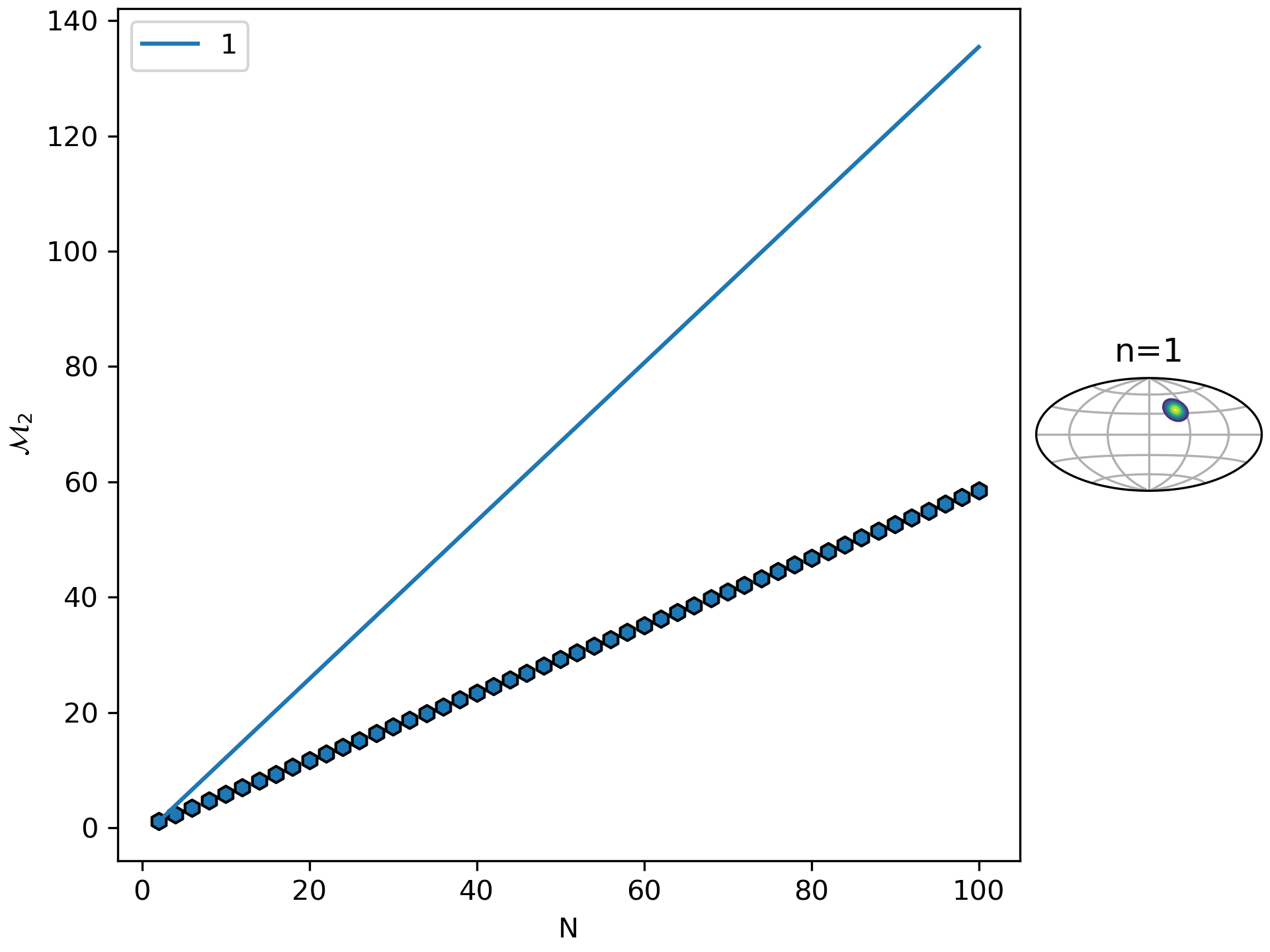
Comparing SRE Scalings
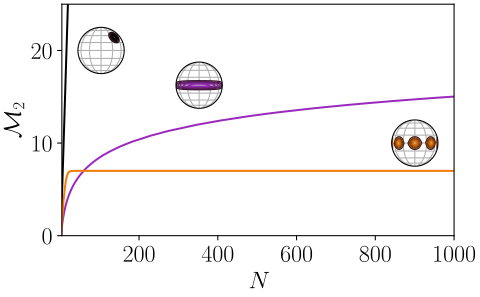
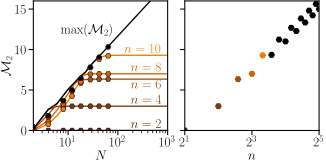
\(\ket{\theta = \acos(3^{-1/2}), \phi = \pi / 4 }\) (black), best squeezed state for TACT (purple), and kitten state with \(n=8\) (orange).
Many-body Bell Correlations
\[\begin{equation}
Q = \log_2(2^N {\mathcal E})<0,\quad
{\mathcal E}= \left|\frac{1}{N!}\ev{\left(\frac{\hat Y +i\hat Z}{2}\right)^N}\right|^2
\end{equation}\]
\(Q \leq 0\) for separable states\(Q \geq N - k\) detects non-\(k\) -separability\(Q = N - 2\) for the GHZ state along x-axis
M. Płodzień, M. Lewenstein, E. Witkowska, and J. Chwedeńczuk, One-axis twisting as a method of generating many-body bell correlations, Physical Review Letters 129, 10.1103/physrevlett.129.250402 (2022)
One-Axis Twisting (OAT)
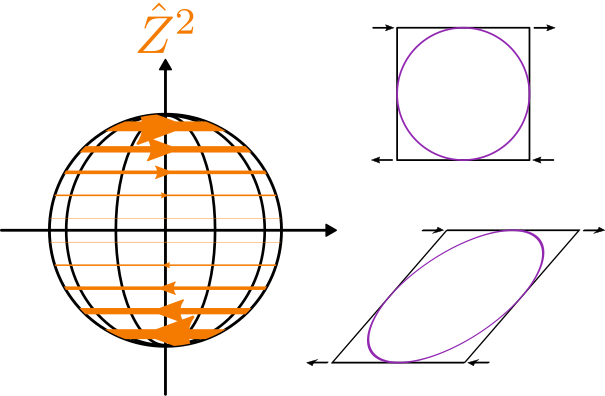
\[\begin{equation}
\ket{\psi(t)} = \exp\left\{-i \frac{\chi t}{4 \hbar}\hat{Z}^2 \right\} \ket{X},\quad \hat{Z} \equiv \sum_j \hat{Z}_j
\end{equation}\]
\[
\xi^2 = N \frac{\min_{\vb*{n}} (\Delta \hat{\sigma}_{\perp, \vb*{n}}^2 )}{\ev*{\hat{X}}^2} \gtrsim N^{-2/3}
\]
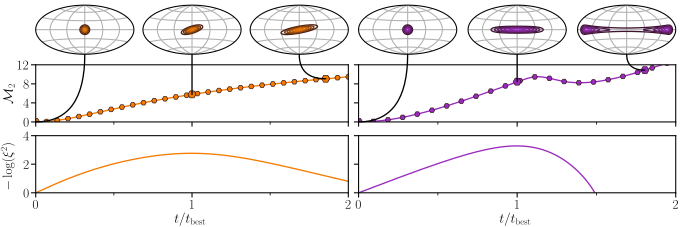
SRE at Squeezing Time Scale
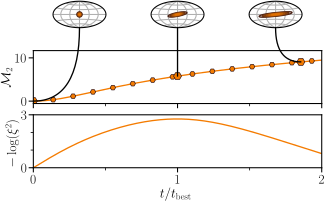
\(t \lesssim t_\mathrm{best}\)
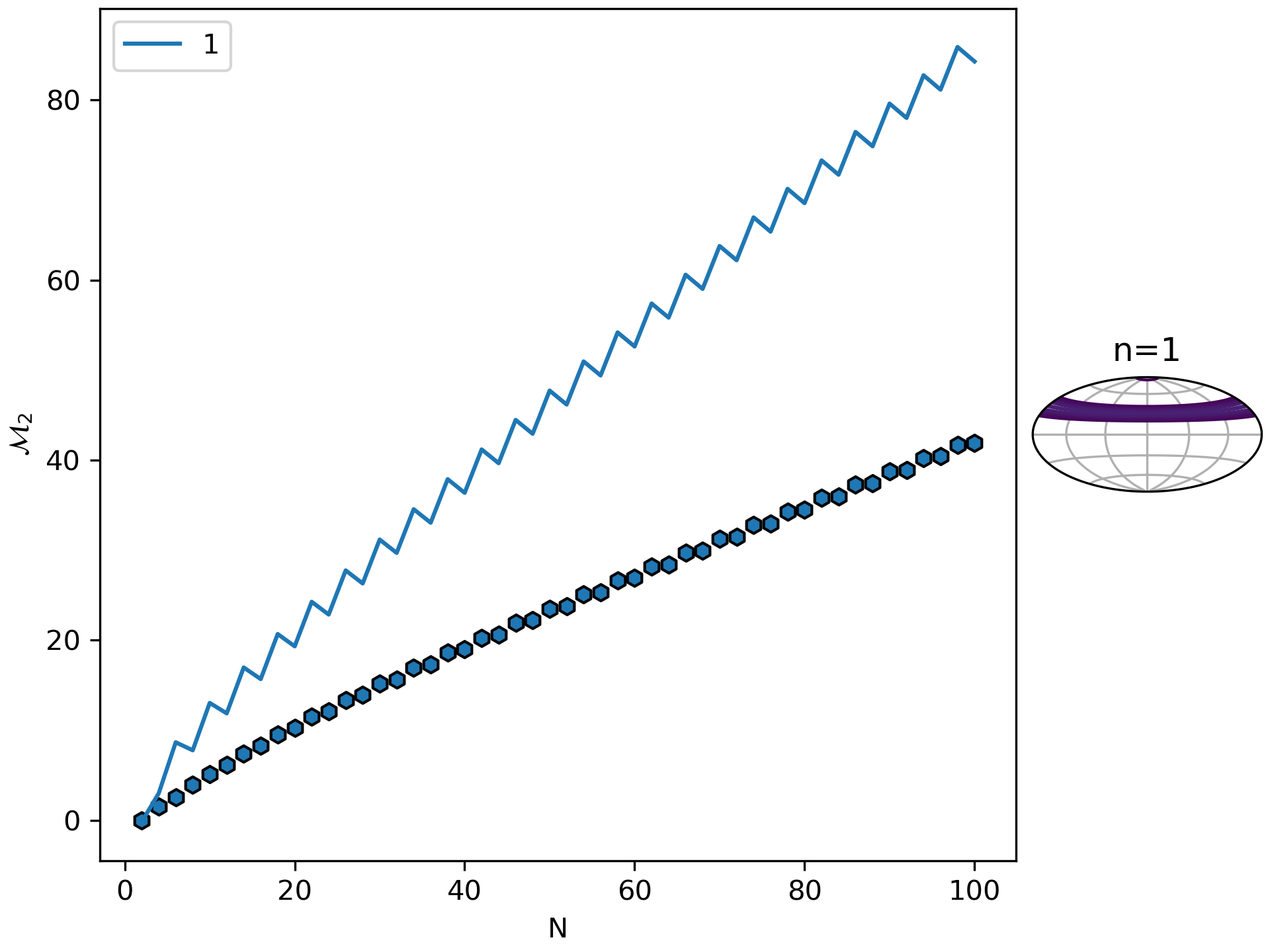
\(N=100\)
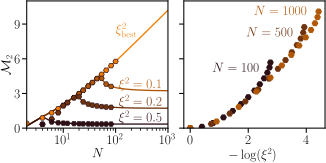
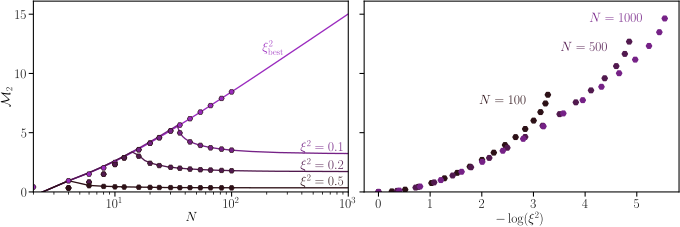
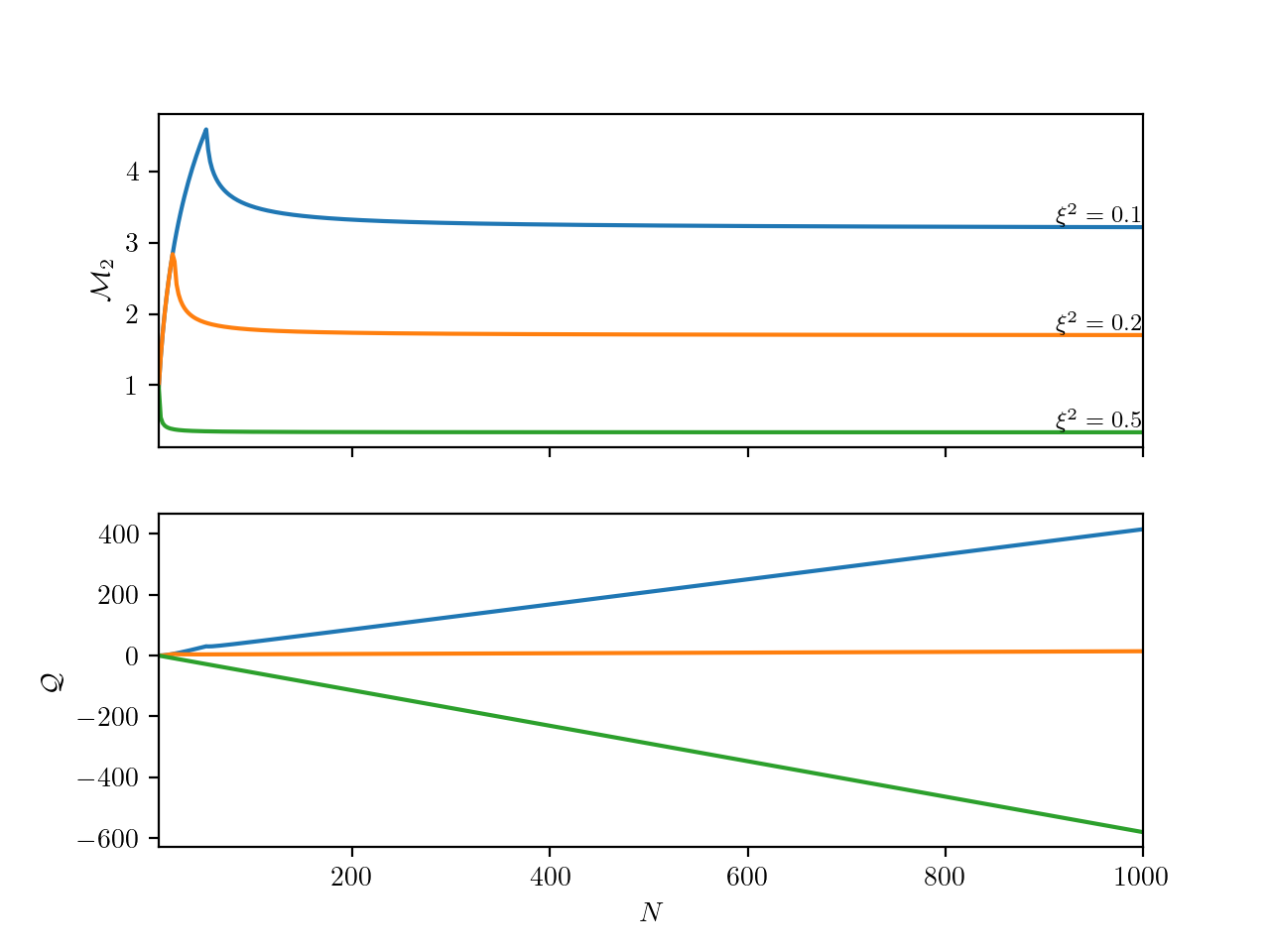
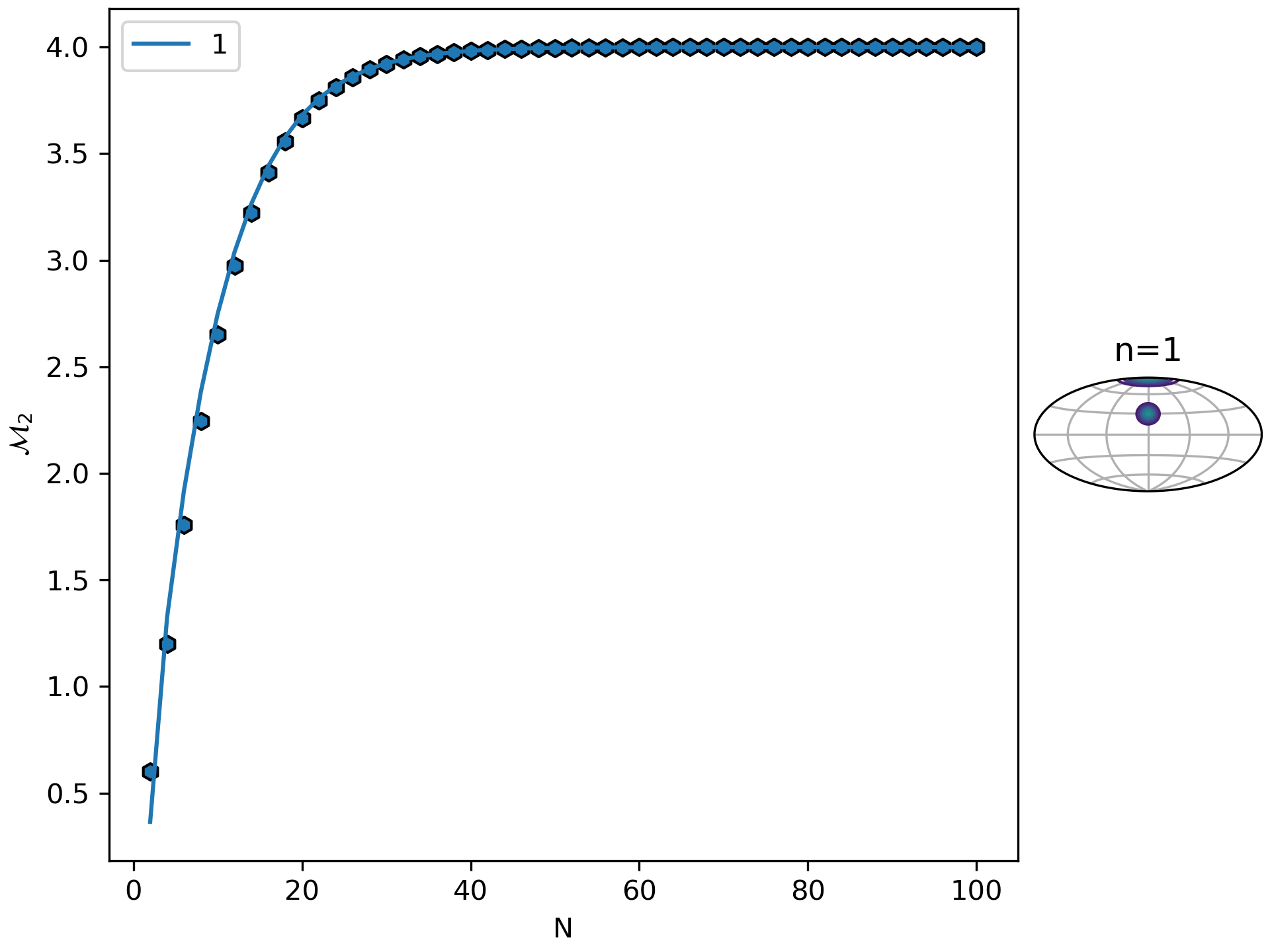
\(Q\) and SRE Scaling of Squeezed StatesAt \(t_{\rm best}\) SRE scales with \(\log_2(N)\) , while \(Q(t = t_\mathrm{best}) \approx N - 4 N^{1/3}\) (anti-correlated )
SRE of Kitten States
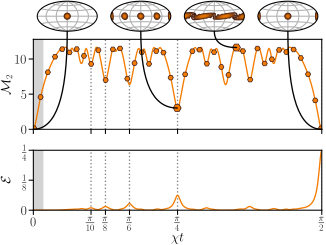
\(\chi t \leq \frac{\pi}{2}\)
\(N=100\)
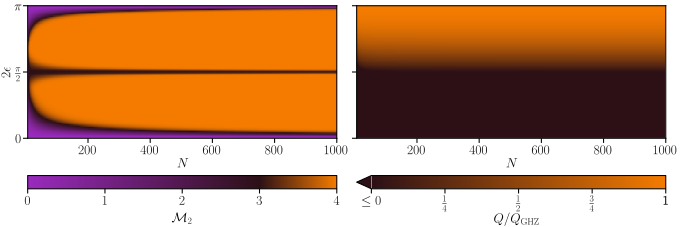
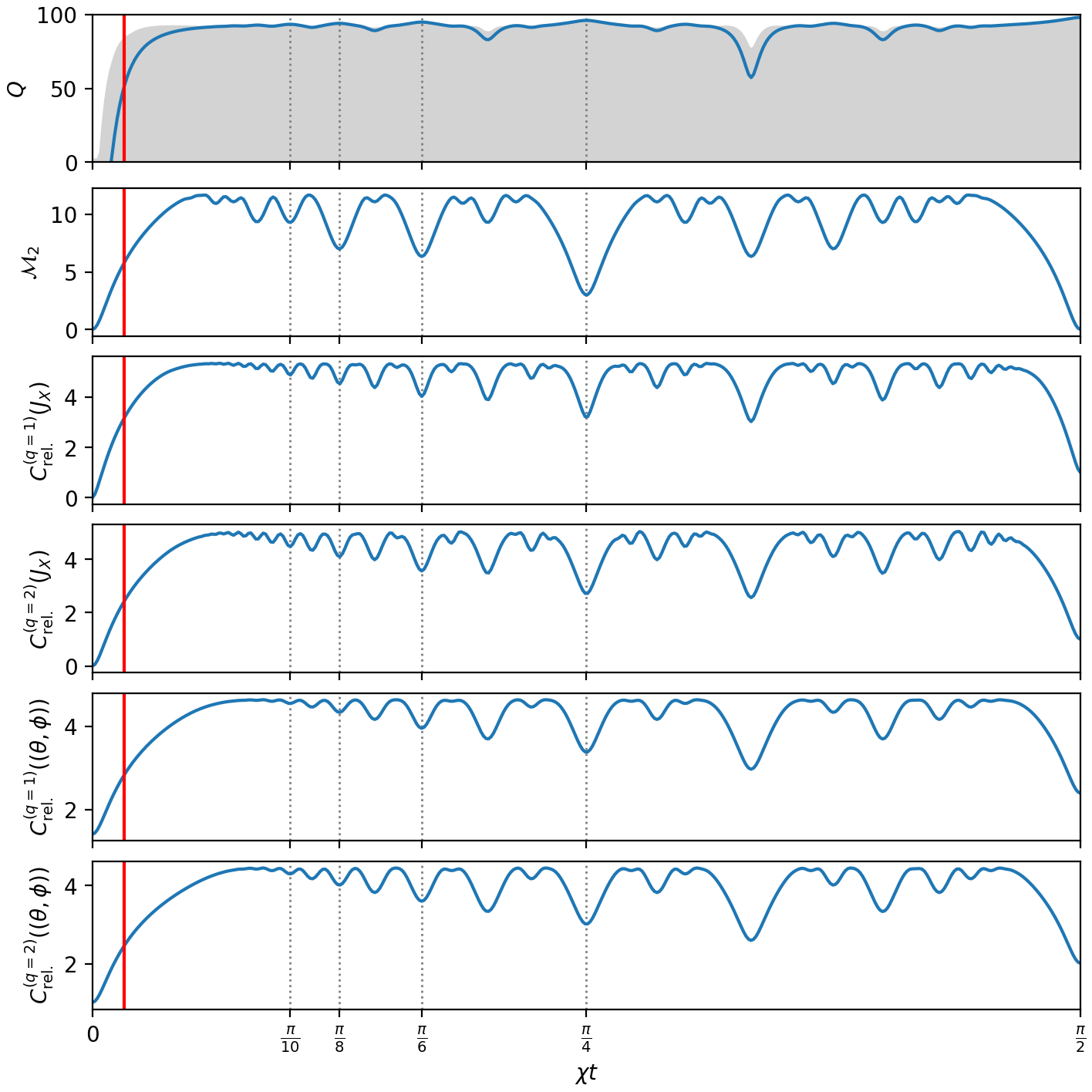
\(Q\) and SRE Scaling of Kitten StatesAt large \(N\) SRE is fixed, but scales with \(\log_2(n)\) , while \(Q \simeq N-2\log_2(n)\) (anti-correlated )
Conclusions
Approximated stabilizer Rényi entropy (SRE) only requires six state projections
For any system size \(N\) , fixing the squeezing level also fixes the SRE
Correlation between SRE and squeezing parameter for best squeezing
Conclusions
Anti-correlation between SRE and Bell correlations \(Q\) for
Best squeezed states (\(\mathcal{O}(\log_2(N))\) , \(\mathcal{o}(N)\) )
Kitten states (\(\mathcal{O}(1)\) , \(\mathcal{O}(N)\) )
Analytical results on Dicke states with \(m=0\) and generalized GHZ states in the paper!
Two-axis Counter-twisting (TACT)
\[\begin{equation}
\ket{\psi(t)} = \exp\left\{-i \frac{\chi t}{4 \hbar}(\hat{Z}\hat{Y} + \hat{Y}\hat{Z}) \right\} \ket{X}
\end{equation}\]
SRE of Squeezed States under TACT
\(N=100\)
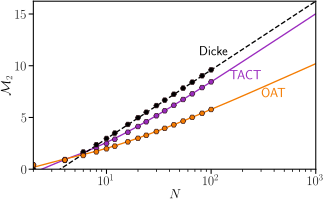
Same conclusions as OAT.
SRE Scaling of Squeezed States under TACT
Same conclusions as OAT.
Dicke States with Zero Magnetization
\[\begin{equation}
\lim_{N\to\infty} \mathcal{M}_q(\ket{J = N/2, 0})
\simeq \frac{q}{q-1}\log_2\left(\frac{\pi N}{8}\right) - \frac{1}{q-1}
\end{equation}\]
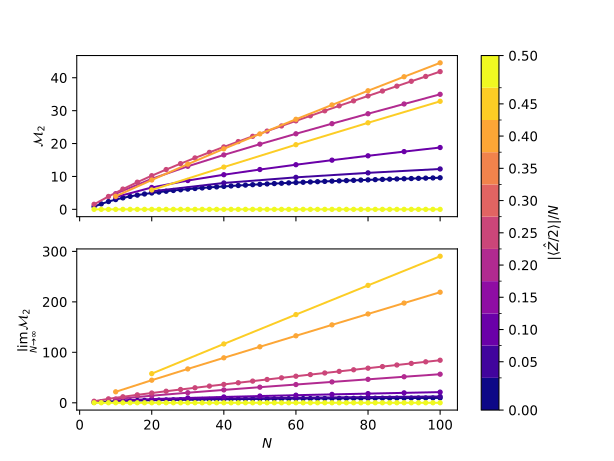
SRE scaling of best squeezed states under OAT and TACT, and \(\ket{J = N/2, 0}\) .
\[
Q \approx N - \log_2 N + \log_2 \frac{2}{\pi}
\]
Generalized GHZ States
\[\begin{equation}
\frac{1}{\sqrt{K}}\left( \ket{\theta=0, \phi=0} + \ket{\theta = 2\epsilon, \phi=0}
\right)
\end{equation}\]
Matrix elements of \(\hat{P}\)
\[\begin{equation}
\bra{\theta_i, \phi_i}\hat{P}\ket{\theta_j, \phi_j} =
(\alpha_{i,j})^{N_X} (\beta_{i,j})^{N_Y} (\gamma_{i,j})^{N_Z} (\kappa_{i,j})^{N_I}
,\end{equation}\] where \(N_\sigma\) denotes the number of distinct Pauli operators \(\hat{\sigma}\) composing the Pauli string.
Implicit constraints:
\(0 \le x \le 1,\quad \forall x \in \{|\alpha_{i,j}|^2, |\beta_{i,j}|^2, |\gamma_{i,j}|^2, |\kappa_{i,j}|^2\}\) ,
\(|\alpha_{i,j}|^2 + |\beta_{i,j}|^2 + |\gamma_{i,j}|^2 + |\kappa_{i,j}|^2 = 2\) .
Feasible constraints on \(\hat{P}\)
\(x_1, x_2, x_3, x_4 \in \mathcal{P}\{|\alpha_{i,j}|^2, |\beta_{i,j}|^2, |\gamma_{i,j}|^2, |\kappa_{i,j}|^2\}\)
No constraints: complicated integral with no advantage over literature results.
\(x_1 = x_2 = 1\) : we only consider matrix elements independent of the system size \(N\) .\(x_1 = 1\) : solvable through beta and gamma functions that yield expression (preliminary, unchecked) which only depends on \(\ket{-Z} = \otimes_{j=1}^N \ket{0}\) .
Approximated \(\ev*{\hat{P}}\)
\[\begin{equation}
\ev*{\hat{P}}
\simeq \sum_{\sigma \in \{X,Y,Z\}} \Bigg(
c_{1,N_\sigma}^{(\sigma)} \bra{\sigma}\hat{P}\ket{\sigma}
+ \frac{c_{2,N_{\overline{ \sigma}}}^{(\sigma)}}{\sqrt{(-1)^{N_{\overline{ \sigma}}}}} \bra{\sigma}\hat{P}\ket{-\sigma}
\Bigg)
\end{equation}\]
Approximated SRE
After some combinatorial calculations, we obtain
\[\begin{equation}
\lim_{N \to \infty} \mathcal{M}_q
\simeq \frac{1}{1-q}\log_2\left( \frac{1}{2}
\sum_{\sigma\in \{X,Y,Z\}}
\sum_{n=1}^2
\sum_{m=1}^2
\left(c_{n, m}^{(\sigma)}\right)^{2q} \right)
\end{equation}\]
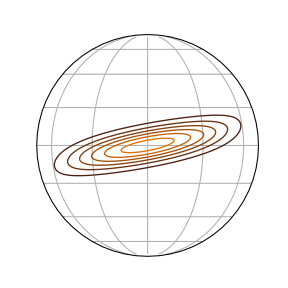
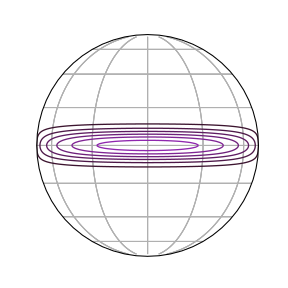
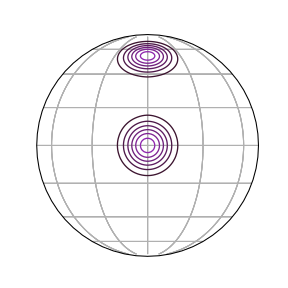
Husimi functions for OAT and \(t < \pi / 2\)
Video
\(Q\) scaling for fixed squeezing level
Coherence and SRE under OAT
\(N=100\)
Dicke states scaling
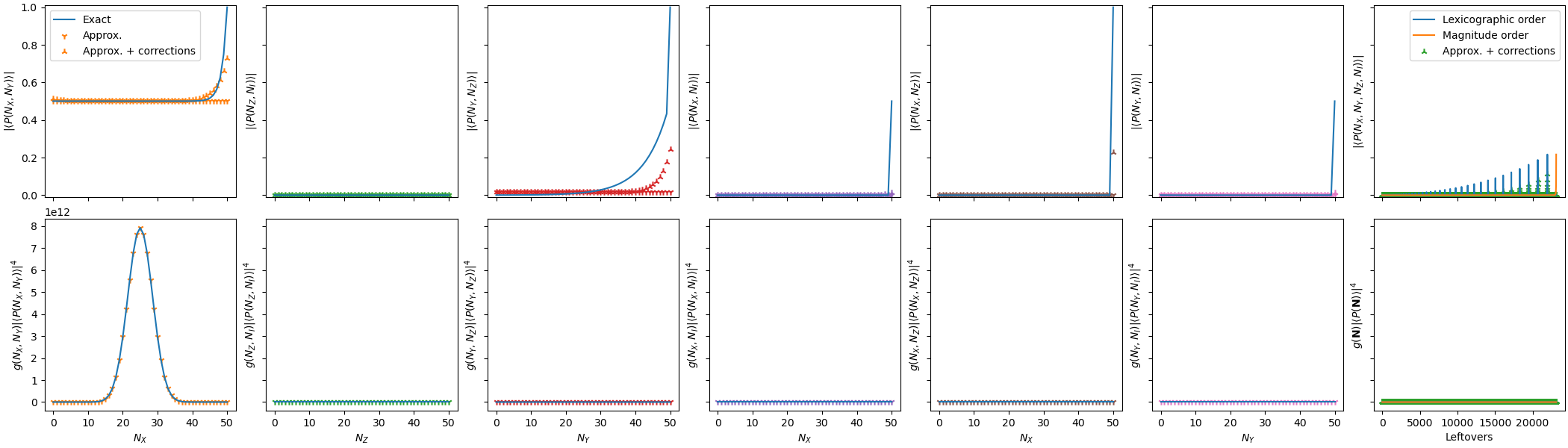
Corrections to the Approximated SRE
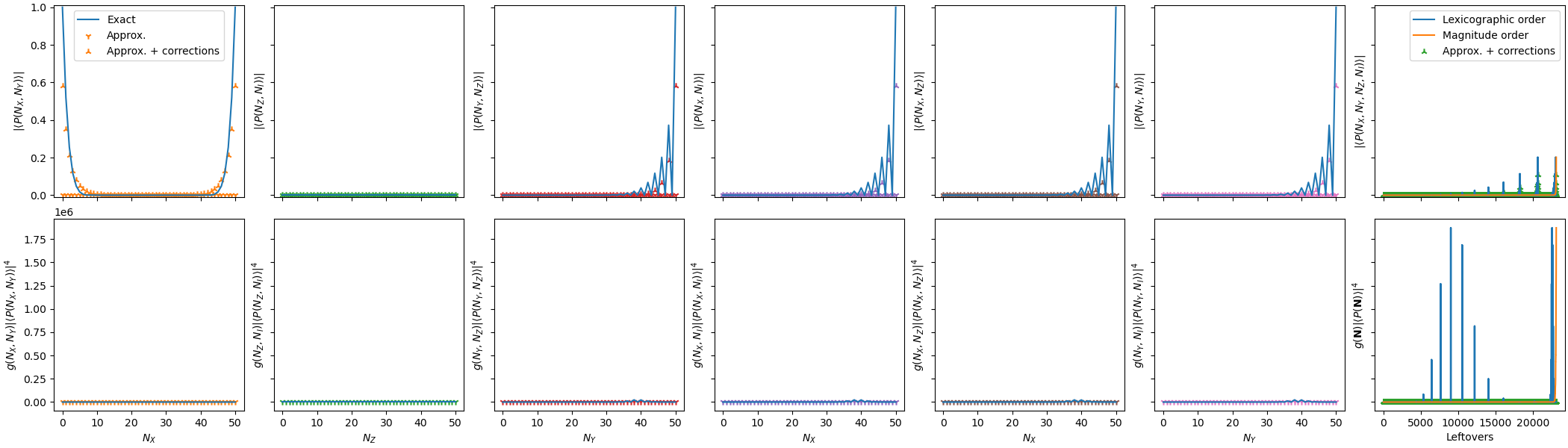
Example state: Generalized GHZ state
\[ \ket{\theta = 0, \phi = 0} + \ket{\theta = \pi/3, \phi = 0} \]
Pauli spectra of generalized GHZ state
\(N=50\)
Example state: Rotated coherent state
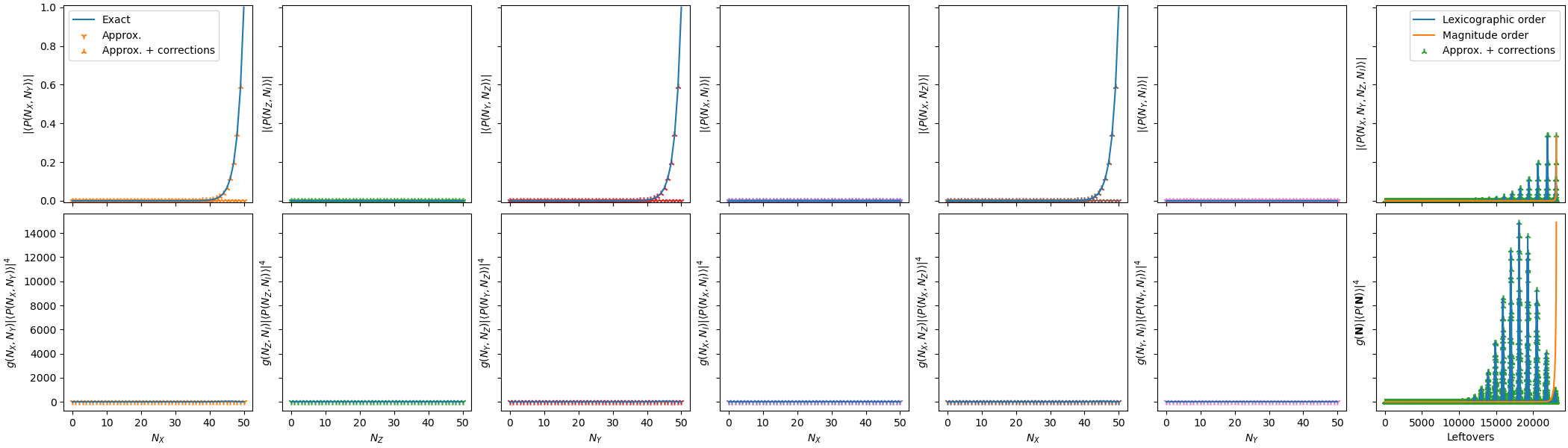
\[ \ket{\theta = \acos(3^{-1/2}), \phi = \pi/4} \]
Pauli Spectra of rotated coherent state
\(N=50\)
Example state: Dicke state with magnetization \(N/4\)
\[\ket{J=N/2, m = N/4}\]
Pauli spectra of Dicke state with magnetization \(N/4\)
\(N=50\)
Magic Resources for Fault-tolerant Quantum Computing
Concatenation could outperform surface code
No universal set of gates with transversal gates only
Non-transversal gates can be generated with non-stabilizer states and post-selection1
Surprisingly cheap compared to other requirements2